There's no single right way to buy medical devices. I've been doing quality and brand compliance review for a mid-sized hospital network for about seven years now. I review every supplier submission, spec sheet, and quote before it reaches our clinical teams—roughly 200+ items annually. If there's one thing I've learned, it's that the same evaluation framework doesn't work for a $400 box of electrodes and a $400,000 surgical platform.
So I stopped pretending it does. Now I split procurement into three scenarios and ask different questions in each. Most buyers fall into one of them—or they're about to.
The dividing line isn't price. It's what happens after the sale. Implants and surgical systems live or die on training and revision support. Emergency and respiratory equipment lives or dies on consumables and uptime. Specialty capital equipment lives or dies on utilization and reimbursement. Same industry, completely different risk profiles.
Scenario A: High-value implants and surgical systems
This is the orthopedic and dental implant world—hips, knees, dental implants, and the instrumentation that goes with them. When we evaluate a supplier like Zimmer Biomet, or any of the other major orthopedic players, we're not just buying hardware. We're buying into a surgical ecosystem.
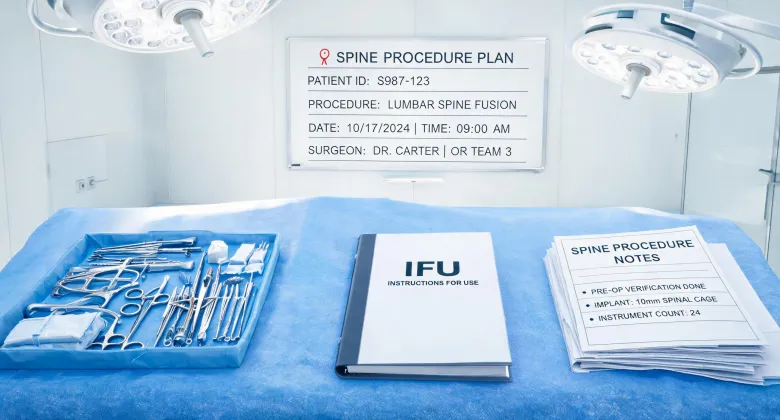
Zimmer Biomet's G7 dual mobility surgical technique is a good example of what I mean. The implant is one line item. The surgical technique guide, the instrument tray, the training pathway for surgeons who haven't used that construct before—those are separate line items, and they don't always show up in the quote. When they don't show up, they show up later.
The same is true for Zimmer Biomet dental implants and really any implant platform. The implant itself is maybe 40% of the actual cost of getting a surgeon up and running. The rest is instrumentation, restorative components, training, and the inventory you have to carry because you can't run out mid-case.
Back in 2022, we ran a comparison between two implant suppliers. The spreadsheet said Supplier B was about 12% cheaper per unit. My gut said something was off—their rep took four days to answer a basic question about sterilization compatibility. We went with B anyway because the numbers were clear. Eighteen months later we were dealing with delayed instrument trays and a $22,000 rework on a batch that didn't match our sterilization protocol. The spreadsheet never captured that.
Now I ask three questions in this scenario. Does the quote include the instrument tray, or is that a separate capital purchase? What's the revision rate, and who covers the cost of a revision? Is surgical training included, or is it billed per seat? If a supplier can't answer those in writing, the per-unit price is noise.
Scenario B: Emergency and respiratory equipment
Defibrillator AEDs, BiPAP machines, and similar devices look like commodities from the outside. They all meet the same basic standards, they all have similar specs on paper. The reality is that total cost of ownership is driven almost entirely by consumables and service—not the sticker price.
Take AEDs. The device might last ten years. The pads and batteries won't. As of January 2025, based on quotes we received in Q1, replacement pad sets for the major AED brands ran roughly $40 to $90 a pair, and batteries ran $150 to $400 depending on the model. A cheaper AED with a two-year battery cycle can cost more over five years than a pricier unit with a five-year cycle. Verify current pricing—these numbers move.
BiPAP machines follow the same pattern. The device is the entry point. The tubing, filters, and mask interfaces are the recurring cost. We run a five-year consumable projection on every respiratory device quote now. It's the only way to compare two machines honestly.
This is where I've been burned by "standardization" arguments (which, honestly, usually means someone doesn't want to redo the training binder). Procurement teams love to standardize on one AED brand or one BiPAP model to simplify training. That's fine, but standardization without a consumable schedule just means you've standardized your hidden costs too.
Scenario C: Specialty capital equipment
Catheter ablation is a good example of this category—and if you're wondering what catheter ablation is, the short version is a procedure where a thin catheter delivers energy to heart tissue to correct an arrhythmia. The equipment is expensive, the procedure requires specialized training, and the reimbursement depends on coding that changes more often than anyone would like.
Here's the counterintuitive part. In our 2023 review of two ablation platforms, the higher-priced capital unit had a lower five-year total cost. Not because of the sticker price—because the per-procedure disposable cost was 18% lower and the workflow was faster, which meant more procedures per lab day. The spreadsheet I built initially only compared capital cost. That was the wrong spreadsheet.
Specialty capital purchases need a different question set. What's the per-procedure disposable cost, and is it locked for the contract term? What utilization rate does the business case assume, and what happens if you hit 60% of it? Does the vendor provide coding and reimbursement support, or is that on you? I've seen a $300,000 capital purchase turn into a $500,000 five-year spend because nobody asked about disposable price escalation.
I check the FDA's 510(k) and recall databases for every capital purchase now—it's public, it's free, and it takes about ten minutes. What I find there has killed more than one deal that looked fine on paper.
How to figure out which scenario you're in
Three questions will place almost any purchase:
Does the device have recurring consumables? If yes, you're in Scenario B or C for cost purposes, even if the device itself looks like a one-time purchase.
Does the clinical outcome depend on a specific surgical technique or training pathway? If yes, you're in Scenario A. The implant is not the product—the ecosystem is.
Does reimbursement depend on the specific device or procedure? If yes, you're in Scenario C. Capital cost is the smallest number in the business case.
If you're still unsure, ask the supplier one question: "What's not included in this quote?" The answer tells you more about which scenario you're in than any spec sheet will.
The question that changes the math
I've learned to ask "what's not included" before I ask "what's the price." That single question has saved us more money than any negotiation tactic I know. The supplier who hands you a quote with everything itemized—training, consumables, service, revision support—will almost always look more expensive on page one. They usually cost less by year three.
Transparency isn't a nice-to-have in medical device procurement. It's the only way the math works. The vendors who hide costs aren't cheaper. They're just cheaper today.