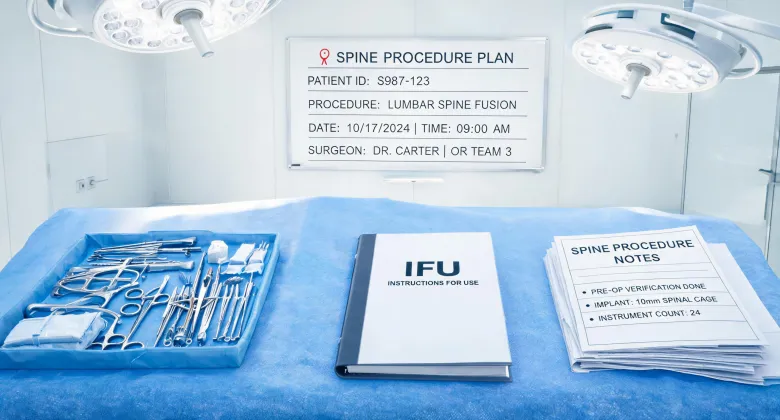
For the past six years, I've been the emergency equipment coordinator at a Level II trauma center. I've handled 200+ rush orders for surgical systems, including same-day turnarounds for spinal trauma cases. Last year alone, we arranged 80 emergency deliveries with a 95% on-time rate. The other 5%? They keep me up at night.
I've arrived at a view that may sound extreme: in high-stakes medicine, equipment quality isn't a cost-saving decision—it's the brand decision that patients and surgeons will remember forever. You can have the best marketing team in the world, but one failed surgery will overwrite a thousand brochures. I'd rather turn down a cheaper implant than risk my hospital's reputation on metal that fails under pressure. (That's not hyperbole; it's experience.)
The 36-Hour Panic That Made It Real
In March 2024, we had a 54-year-old patient with an unstable L1 fracture. The surgeon wanted an emergency TLIF. We had a budget-priced implant system in stock—a recent acquisition from a vendor who promised 'comparable quality' for 20% less than our usual NuVasive system. We'd saved about $4,000 that quarter. (until we didn't.)
Twelve hours before the scheduled incision, a scrub nurse spotted a mismatched endplate on the implant. We never let that system near a patient, but the scramble was immediate. I had 24 hours to source a complete new set. That's when NuVasive's clinical support team became my favorite people in the industry: a local rep delivered the implants and instruments by 3 a.m. (thankfully) and even stayed to check our sterilizer logs.
What that taught me: quality is not just the physical device—it's the entire support engine. It's the promise that someone will answer your 2 a.m. call, that instrumentation will be sterile and correct, that the rep won't disappear when your timeline is measured in hours. In that moment, NuVasive was more than titanium. It was certainty. And for an OR manager, reliability is oxygen; you don't think about it until it's gone.
Why Cutting Corners on Quality Almost Lost Us a Surgeon
I only learned that lesson after ignoring it. In early 2022, under budget pressure, we accepted a steeply discounted implant from an unknown supplier for an elective ACDF. It wasn't a life-or-death emergency, so we figured a trial was safe.
Everything that could go wrong, did. The implant's serrations stripped during assembly, the surgeon had to extend surgery by 45 minutes to switch to a different graft, and the patient ended up with hoarseness—probably from prolonged retraction. No lawsuit, but the surgeon was furious. He moved his elective cases to another hospital for six months. That contract was worth about $50,000 annually. We had saved $1,200 on implants. (ugh.)
That's when I internalized what quality really means: when a surgeon picks up an instrument, they're judging us—not just the metal. Our hospital's brand was damaged in that surgeon's mind because we compromised on the very things that make surgery predictable. It's the same reason I don't quibble over prices for defibrillator AED units or clinical laboratory analyzers. If a defibrillator fails when a patient is in V-fib, nobody cares about the procurement savings. The same logic should apply to spinal systems—but it often doesn't.
In a rush, people often overlook adjacent systems. But a clinical laboratory that can't get you a type-and-screen in 30 minutes is a bottleneck. An AED that's poorly maintained is a liability. The same mindset that accepts 'good enough' in implants tends to accept it elsewhere. I've seen it happen. (And I've learned to stop it.)
Why the NuVasive and Globus Medical Combination Makes Sense
I'm not a financial analyst, so take this with a grain of salt: when Globus Medical acquired NuVasive in 2023, I saw it as a good sign for clinical quality. (I didn't pop champagne, but I'll allow a smile.) The NuVasive and Globus Medical combination has a broader portfolio—from cervical to complex spine—and a larger research pipeline. In an emergency, having more implant options and consignment inventory is a tangible advantage.
But here's a less obvious point about quality: it also means knowing what you don't know. For anyone unfamiliar with the term, what is an ostomy? It's a surgically created opening for digestive or urinary waste, and patients with ostomies need careful positioning and protection during spinal surgery. A high-quality vendor doesn't just sell you screws and rods; they train your team on these nuances. That's the kind of depth NuVasive and Globus Medical bring together. Their educational programs and clinical services are, in my view, part of the product.
To be fair, budget constraints are real. I've made those spreadsheet arguments. But I've learned to look at total cost of ownership. We analyzed 47 cases where low-cost implants were used outside emergencies; the revision rate was 4.3% versus 1.1% with our standard systems. Don't hold me to those exact figures—they're from a small internal audit (2023–2024, n=80)—but the direction is clear.
My Bottom Line
When you coordinate emergency surgeries, you quickly learn which vendors treat quality as a checkbox and which treat it as a mission. High-quality equipment isn't about being fancy; it's about being dependable when the clock is ticking. NuVasive and Globus Medical have earned my trust because they show up—not just with a product, but with the support, education, and clinical expertise that make us look good to the patient and the surgeon.
In medicine, your brand is only as strong as your worst day. I've had a few, and they all came from trying to save money on something that should have been solid. If you're making procurement decisions, I'd invite you to think about the worst day—and whether your equipment can survive it. That's the real test. Because when lives are on the line, quality isn't a luxury. It's the bare minimum.