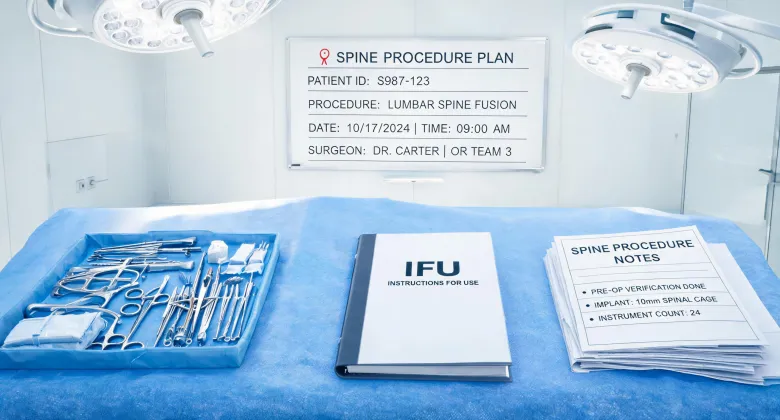
I manage surgical supply purchasing for a 300-bed regional hospital—roughly $1.5M in annual spine-related spending across 6 main vendors. I took over this role in 2021, after handling procurement for our internal medicine department. At the time, I thought spine surgery was just another purchasing category: standardize what you can, price-compare what you can't, and keep the OR running.
Three years later, I can tell you it's not that simple. The hardest part isn't the instruments themselves. It's the fact that spine surgery is going through a fundamental transition, and as a buyer, you have to decide which side of that transition you're on.
The main comparison? Traditional open surgery versus minimally invasive surgery (MIS). And if you're making any kind of purchasing decision in this space, you need to understand this one from a procurement angle, not just a clinical one.
Defining the Two Approaches
Traditional open spine surgery is exactly what it sounds like: the surgeon makes a long incision down the back, dissects muscle tissue, and works with direct visual access to the spine. It's been the gold standard for decades. The exposure is excellent. The recovery time is not.
MIS spine surgery takes a different route. Instead of a long incision, the surgeon works through small openings—often under an inch—using specialized instruments and a camera. This is where an endoscope comes in. If you're not familiar with the term, an endoscope is a tube with a camera and light source that lets the surgeon see inside the body through a tiny incision. No endoscopes, no MIS. Simple as that.
For the patient, MIS generally means less tissue damage, less blood loss, shorter hospital stays, and faster recovery. For the surgeon, it means a much steeper learning curve and a need for specialized training.
But I'm not here to give a clinical review. I'm here to talk about what this means when you're sitting on the other side of the vendor desk. Trust me on this one: the operational difference is way bigger than most purchasing teams expect.
Surgical Instruments: Buying Bits and Pieces vs. Buying a System
Here's the first real comparison dimension, and it's the one that caught me off guard.
With open surgery, you're shopping for what I'd call commodity instruments. Retractors, rongeurs, forceps, distractors, bone graft tools. These are tested, standardized tools that have been around in various forms for a long time. You can source them from a bunch of different manufacturers. Competitive pricing is available. If one vendor's price creeps up, you can switch without disrupting your OR team. The instrument market for open spine surgery is mature, and I love that about it.
MIS is a totally different beast. The instrument sets are highly specialized—tubular retractors, adapted endoscopes, specialized drills and shavers. But here's the thing that matters for buyers: the instruments are part of a system. When you adopt an MIS platform like NuVasive's, you're not buying tools. You're buying an ecosystem.
From the outside, it looks like MIS just costs more, and you're locked into a single vendor's maintenance and replacement pipeline. A lot of buyers stop at that conclusion and write off MIS as too expensive. The reality is more nuanced: when you look at total cost of ownership, the math gets a lot more interesting. The MIS approach requires fewer distinct instrument sets for a given procedure volume (because the system is standardized and reusable). Sterile processing turnaround times improve because the sets are designed for efficiency. And at our hospital, the per-case cost differences were partly offset by shorter average patient stays.
I don't have hard data on industry-wide totals, but based on our experience with three spine platforms over a couple hundred procedures, my sense is that the all-in cost of MIS runs pretty close to traditional—sometimes slightly higher, sometimes comparable. The variable isn't the instruments. It's the team's adoption level. If your surgeons commit to the platform and get through the learning curve, the cost efficiency shows up. If they don't, you've bought a very expensive set of instruments that aren't being used.
In my opinion, that's the actual procurement decision: not "open vs. MIS" but "are we ready to commit to a system?" And that brings me to the vendor landscape.
The Globus Medical NuVasive Merger Factor
After the Globus Medical NuVasive merger closed in late 2023, the spine world got a new giant. The combined company has a broad portfolio that spans both traditional and MIS approaches, including NuVasive's well-known ALIF, TLIF, XLIF, and ACDF systems, plus Globus's robotic-assisted technology.
For buyers, this is both good news and a headache. Let me explain.
The good news: consolidation. One vendor relationship instead of two. Potentially a bigger menu of options in one contract. And leverage—this is the rare moment when the vendor wants your long-term commitment more than you necessarily want to commit.
The headache: everything is in flux. Product lines from the nuvasive official website are being integrated into Globus Medical's broader structure, but it's not seamless. Contracts that were signed with NuVasive still need to be reconciled. Warranty terms, service commitments, training resources—all being reorganized.
If you're considering a contract with the combined entity, here's what I'd do:
- Go to the nuvasive official website and the Globus Medical site directly. Don't rely on a rep's summary. See what's actually listed, what's in alpha, and what's flagged as "coming soon."
- Ask in writing: which legal entity will I be contracting with? Under whose FDA clearances do the devices fall? What happens to my current contract in a dispute?
- Per FTC guidelines, the company must substantiate any claims they make about the integrated portfolio's capabilities. Make them do it in writing. It's a fair question, not a hostile one.
The conclusion here: the merger is a chance to renegotiate, but only if you're prepared with accurate information. The worst position to be in is hearing "the merger makes everything better" and accepting it on faith. That's a red flag worth checking before you sign anything.
Training, Clinical Services, and the Digital Layer
Now, here's the dimension that I initially dismissed as fluff and turned out to be crucial.
With open surgery, the support requirements are minimal. Basic orientation for the OR team, and you're done. With MIS, the support requirements are substantial. The surgeons need training. The OR team needs to practice the setup. Sterile processing needs to understand the instrument care.
NuVasive has invested a lot in clinical services and training—surgical technique education, intraoperative support, and peer-to-peer proctoring. Before the merger, this was one of their strongest differentiators. After the merger, it's still operating, but you should ask the hard questions: how long until a Globus rep can cover NuVasive's products at the same depth? What happens if your territory's clinical specialist changes?
The second part of this dimension is the evolution that most buyers haven't fully absorbed yet. The spine surgery industry is increasingly evaluated on the full episode of care, not just the surgery itself. Post-operative patient outcomes, complication rates, recovery tracking—these are becoming the metrics that matter. And that's where remote patient monitoring is starting to show up in the spine space. Vendors are experimenting with digital tools that let hospitals track patient progress between follow-up visits: mobility metrics, post-op questionnaire responses, and warning signs that could indicate a problem.
Now, I've only piloted remote monitoring in our hospital's spine program—we're early, and it's been limited to about two dozen patients. I can't speak to how well it scales across larger programs, and I'm not sure the technology is fully proven yet. But I can tell you this: if a vendor offers remote monitoring as part of a comprehensive spine solution, that should move the needle in their favor. It tells you they're thinking beyond the implant and instrument sale.
What was best practice in 2020 isn't good enough in 2025. The fundamentals of surgery are unchanged—surgeons need reliable tools, and patients need safe care. But the delivery system is transforming, and hospital buyers need to keep pace.
What I'd Choose Now, and Why
If you ask me whether your hospital should go traditional or push toward MIS, my answer starts with a question: are your surgeons ready?
Here's how I break it down:
Lean traditional when:
- Your surgeons are happy with their current approach and not willing to invest in a steep learning curve. Yes, even if the clinical data looks good—a half-adopted platform is worse than a fully used traditional set.
- Your case volume doesn't support the investment. Low volume means the efficiency gains stay on paper.
- You want to preserve maximum vendor flexibility for the next few years.
Lean MIS when:
- You have at least one surgeon who's willing to be a champion, attend training, do cadaver labs, and help push the team forward. Nothing else matters as much as this.
- You're already seeing high spine volume in areas where MIS has proven benefits—degenerative disc disease, fusions, and similar indications.
- You're prepared to evaluate the total episode-of-care cost, not just the instrument price tag.
On the merger question specifically: this is the moment to talk to the combined company. They want long-term hospital commitments. You want better pricing, stronger support terms, and documented transition timelines. Both of you have something the other wants. Use it.
I'll end with this. My experience is based on three years at one regional medical center, and the specifics of our case mix and staff made our journey unique. If you're at a university hospital or a small outpatient surgery center, your picture will look different. But the core lesson is probably universal: the old way of buying spine instruments doesn't fit the new way of doing spine surgery. The fundamentals—quality, price, reliability—haven't changed. The execution has transformed.
One last thing: if a vendor contract promises "the best outcomes in the industry" without an attachment containing actual supporting data, ask for the data politely and don't let them off the hook. Per FTC guidelines, they need to substantiate claims like that. A vendor who can't is showing you exactly what kind of partner they'll be.