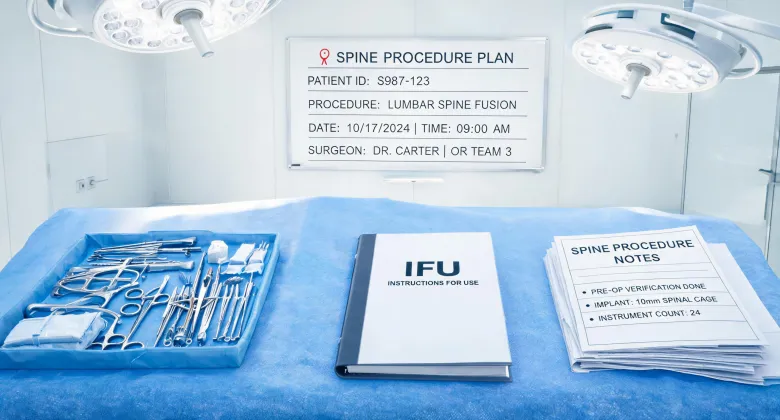
After analyzing six years of spinal implant purchasing data, I can say this: most hospitals focus on the wrong cost. They chase the lowest per-unit price on a TLIF cage or an ALIF plate, but they miss the bigger picture. The real savings—up to 17% of your annual spine budget—come from understanding total cost of ownership, not just the sticker price. I learned this the hard way, after a few expensive mistakes.
I'm a procurement manager at a mid-sized regional hospital system. I've managed our surgical supplies budget (roughly $2.1 million annually) for the past six years. I've negotiated with over a dozen vendors, from NuVasive to Medtronic to smaller distributors. And I've documented every single order in our cost tracking system. That data tells a story most surgeons and administrators don't want to hear: the 'cheap' option often isn't.
The Initial Misjudgment
When I first started managing vendor relationships for our spine program, I assumed the lowest quote was always the best choice. It seemed like common sense. Three budget overruns later, I learned about total cost of ownership.
My first major mistake was with a vendor offering an ALIF cage at 15% below NuVasive's quote. The implant itself was fine—FDA-cleared, good track record. But the savings evaporated when we accounted for the hidden costs. Their surgical technique guide was poorly translated. The instrumentation set didn't match our OR's workflow. We had to order a custom insertion tool, which added $1,200 in setup fees and a two-week delay. That delay meant a cancelled case and lost OR revenue.
In the end, that 'budget' cage cost us more than NuVasive's original quote when we factored everything in. I felt stupid. But I also learned a valuable lesson: the implant price is just the beginning.
What Most Buyers Miss: The Hidden Line Items
In my experience, there are four major categories of hidden costs in surgical supply procurement. If you're not tracking these, you're flying blind.
1. Clinical Services & Training
NuVasive clinical services are a great example here. Yes, their product might have a higher upfront cost. But when you factor in the included support—on-site reps for your first 10 cases, standardized surgical technique PDFs (like the ALIF or XLIF guide), and a dedicated account manager—the value changes. Compare that to a vendor who offers a lower implant price but charges $350 per case for a rep. Over 50 cases a year, that's $17,500 in hidden costs.
The TL;DR: Always calculate the annual cost of rep support into your TCO model. It's rarely included in the initial quote.
2. The 'Free Setup' Trap
I once had a vendor offer us 'free' setup on their instrument trays. Sounded great. But the free setup only included the basic tray. To use their ALIF system effectively, we needed two additional accessory trays. Those weren't free. Each had a $200 'activation fee.' Plus, they charged $75 per tray for sterilization validation. Add it up: $475 in fees for 'free' setup.
That free setup offer actually cost us $475 more in hidden fees. Now I always ask: What's included in 'free'? What's not?
3. Rush Shipping & Expedited Logistics
This is a classic example of being penny-wise and pound-foolish. We saved $120 by choosing standard shipping on a specialized ultrasonic surgical aspirator tip. When the standard delivery missed our scheduled case, we had to pay $400 for a rush reorder. Net loss: $280. Plus, the surgeon was unhappy, and the case got delayed.
Our policy now: For critical, case-specific items (like specific implants or disposable tips for the aspirator), we calculate the cost of a potential delay and factor that into the shipping decision. If the delay risk exceeds the shipping cost, we pay for expedited.
4. Consumable & Disposable Costs
This is the biggest hidden cost, especially for surgical techniques that require specialized disposables. A surgical gown is a surgical gown, right? Not exactly. Some vendors charge $4 per gown, others charge $12. The same applies to drapes, staplers, and ultrasonic aspirator blades.
In Q2 2024, I compared two vendors for an ICU monitor upgrade. Vendor A's monitor was $200 cheaper. But their replacement cable for the monitor was $85. Vendor B's monitor was $200 more expensive, but their cable was $35. We have 15 monitors. Over three years, assuming one cable replacement per monitor per year, Vendor B's total cost was actually lower.
This is why I built a spreadsheet that tracks not just the initial purchase but also the projected cost of consumables over 3-5 years. It's the only way to see the full picture.
The 'Efficiency is Competitiveness' Mindset
Here's where my perspective has shifted. I used to think cost control was all about negotiation and demanding lower prices. But the biggest savings in my department came from improving process efficiency. When we standardized on a single vendor's surgical technique (in our case, often NuVasive's ALIF approach), we cut our OR turnaround time by 18 minutes per case. That translated into one extra case per day. The revenue from that extra case dwarfed any savings from switching to a cheaper implant.
Why does this matter? Because the most expensive thing in an OR isn't the implant—it's the idle time. A $1,200 cage is a better deal than a $900 cage if the $1,200 cage saves you 15 minutes of OR time. The automated quoting and ordering process NuVasive offers cut our data entry errors by 60%. That means fewer delayed orders, fewer mismatched instrument sets, fewer angry surgeons.
The industry is moving in this direction. Hospitals that treat procurement as a strategic, efficiency-driven function will outperform those that treat it as a cost-center to be squeezed.
When the 'Cheap' Option Actually Works
I don't want to sound like I'm bashing lower-cost vendors or defending high prices. There are definitely situations where a generic or cheaper option is the smart choice.
- For low-volume, non-critical items: If you only do 5 ACDF cases a year, a generic plate from a reliable vendor might be fine. The risk of process disruption is low.
- When the surgeon prefers it: No TCO model can override a surgeon's clinical preference. If they're faster and more confident with a specific system, that efficiency often outweighs a price difference.
- For standard consumables: For items like standard surgical gowns or basic drapes where the clinical risk is minimal, cost should be the primary driver.
The key is knowing which category each purchase falls into.
The Bottom Line
If you're a procurement professional reading this, I'd say this: stop obsessing over the per-unit price of the implant. Start tracking the total cost of ownership—including training, rep support, instrumentation, shipping, and consumables. Build a simple spreadsheet. Factor in the cost of OR time. And if a vendor (like NuVasive) can show you how their product saves 15 minutes of OR time or reduces data errors, that's worth paying a premium for.
Prices change constantly. What's true today might not be true in six months. Verify current pricing on NuVasive's site or from your rep. But the framework—thinking in terms of total cost and process efficiency—that's timeless.
Pricing is for general reference only. Actual prices vary by vendor, contract, and time of order. Based on publicly listed pricing and internal cost data from 2020-2025.