The Announcement Everyone Expected, But Nobody Fully Prepared For
When Globus Medical announced its acquisition of NuVasive in early 2024, the news cycles were predictable. Stock analysts ran their numbers. The orthopedic press ran their speculation pieces. Surgeons in my network? They mostly asked one question, which I've heard at least fifteen times in the past nine months: "So... do my instrument sets change?"
It's the right question, but it's also the surface-level one. The real answer is more layered.
I work in quality and brand compliance for a medical device company (not Globus or NuVasive, but adjacent). I review roughly 200+ unique product and marketing deliverables annually for a company that does a healthy volume in spinal implants. I've been doing this long enough to have watched three other major orthopedic acquisitions play out—how they handled integration, how they managed surgical technique guides, what broke and what didn't. So when the Globus-NuVasive merger was announced, I paid attention.
Here's what I think actually matters.
The Surface Question: Will My NuVasive Products Disappear?
Short answer: not immediately. If I remember correctly, the acquisition was structured as a $3.1 billion all-stock transaction. Globus gets NuVasive's entire portfolio—TLIF, ALIF, ACDF, XLIF systems, the surgical instrumentation, Pulse platform, the works. But integration at this scale takes 18–24 months minimum.
The FDA doesn't move on anyone's timeline but its own. Any product label changes, new brand names, or combined packaging require regulatory submission. So for at least the next year, what a surgeon orders as a NuVasive XLIF implant is still going to come in a box that says NuVasive on it. That hasn't changed.
The surprise for many—and I say this from having talked to a few procurement folks—wasn't the acquisition itself. It was that Globus and NuVasive overlap in spine surgery products more than either company publicly acknowledged. They were direct competitors in interbody devices. They both have strong MIS (minimally invasive surgery) offerings. So the integration isn't about bringing completely different product lines together; it's about rationalizing two similar ones.
Which raises the deeper question.
The Real Issue: What Happens to Surgical Technique Guides and Quality Standards?
Here's where my quality inspector brain kicks in.
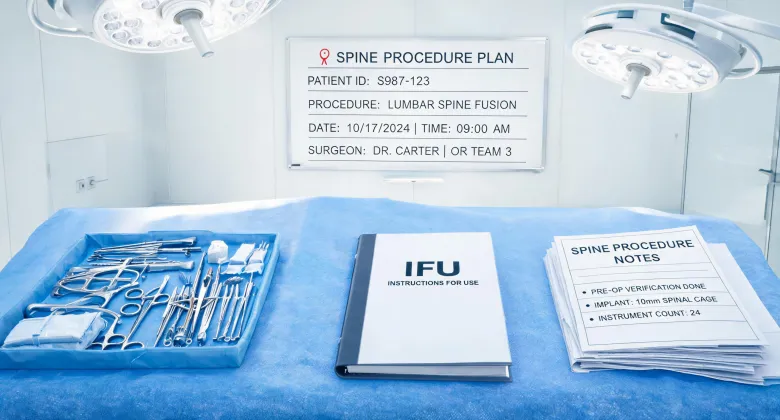
A NuVasive XLIF procedure uses a specific retractor system, specific implants, specific steps that have been validated and documented in the surgical technique guide. A Globus procedure for the same approach? Different retractors. Different implant dimensions. Different lordotic angles, sometimes. Two different systems that achieve similar clinical outcomes through different mechanical execution.
In Q1 2024, I reviewed a surgical technique guide integration proposal for a different acquisition. The thing that everyone underestimated was the inconsistency in spec tolerances. Globus and NuVasive both have excellent quality systems (they have to, for FDA compliance). But their internal standards for things like implant surface finish, packaging seal integrity, and instrument corrosion resistance are not identical. They're both within regulatory range, but "within spec" isn't the same as "identical across brands."
If I remember correctly, in the Medtronic-Covidien integration back in 2015, one of the first pain points was that surgical instrument trays from the two companies had different pin placement patterns for the same type of retractor blade. Surgeons noticed. Not because it affected patient outcomes, but because it broke their rhythm. That kind of thing matters more than most analysts account for.
Dodged a bullet on my end—we weren't involved in that integration. But I watched the fallout.
The Cost of Not Thinking About Integration Early
Saved $80 once by not sending a package expedited. Ended up spending $400 on a rush reorder when it didn't arrive in time. That's micro-level, but the principle scales.
For hospitals and surgeons using NuVasive products:
- Instrumentation compatibility. If you have NuVasive XLIF retractors and Globus implants get introduced into the same OR eventually, they may or may not work together. The surprise isn't the upfront cost. It's the delayed cost of re-training staff and possibly buying new instrument sets.
- Surgical technique documentation. Every spine surgeon I've worked with has a preferred technique guide. They've memorized the steps. If those get revised or re-branded under the Globus name, there's a learning curve. Even if the steps are identical, the visual reference changes.
- Clinical support. NuVasive's clinical services team is fairly robust. Globus's is too. But which reps serve which accounts post-integration? That's a people problem, not a product one, and people problems are harder to spec out in a contract.
A budget vendor decision looked smart on paper for a project I worked on in 2022. Until we saw the quality. Reprinting cost more than the original 'expensive' quote. Same logic applies here: choosing to ignore integration planning to save short-term effort usually costs more to fix later.
What Should Surgeon and Hospital Procurement Actually Watch For?
I'm not going to tell you the sky is falling. It isn't. Both Globus and NuVasive are established companies with good regulatory track records. But I've seen enough integrations to know where the friction points usually hide.
First: instrument compatibility. If your OR is heavily invested in NuVasive-specific instruments, have a conversation with your Globus rep about whether those will be supported long-term. Or whether the plan is to transition to a unified instrument platform. The answer probably exists internally at Globus right now (though I might be misremembering the timeline they announced). Ask for it.
Second: surgical technique guide continuity. In my experience, the first thing that gets updated in an acquisition is marketing collateral. The second is the surgical technique documents. The last is actual product packaging. Pay attention to when your preferred NuVasive technique guide gets a "Globus Medical" logo on it. That's your signal that the integration phase has started.
Third: pricing and contracting. Normally, acquisitions trigger renegotiation windows. You may see new pricing proposals within 12–18 months of close. According to what I've seen in similar deals, pricing adjustments of 10-20% on certain implant lines aren't unusual post-merger (based on industry acquisition data, 2024; verify current rates with your rep). That doesn't mean prices go up across the board. Some products get cheaper as the combined company rationalizes SKUs. But pay attention.
The Part Nobody Talks About: Quality Consistency Across Brands
I want to say this carefully, because I don't have access to Globus or NuVasive's internal quality data. But I've audited suppliers who work with both companies. And there's a difference in how they specify tolerances.
NuVasive's surface finish spec on certain PEEK interbody implants is, in my experience, slightly tighter than industry average. Globus has excellent specs too—especially on titanium implants—but they're not the same. Standard color tolerance for a brand-critical component is Delta E < 2 (meaning the color difference is imperceptible to most people). Above Delta E 4, it's visible to almost anyone. Neither company publishes their internal Delta E targets publicly, but when you integrate two quality systems, the question becomes: whose spec survives?
At least, that's been my experience with medical device integrations. The acquiring company typically imposes its quality standards. That means NuVasive suppliers may have to retool to Globus's spec. Or vice versa. Or a new combined standard gets created. Each option has cost implications that eventually show up somewhere.
So What's the Verdict?
I think the Globus-NuVasive acquisition is probably a good move for both companies. The combined portfolio is genuinely strong—XLIF plus Globus's robust screw and rod systems covers a lot of surgical approaches. The efficiency play is real: combining R&D, regulatory, and manufacturing overhead reduces cost per unit. Switching to a more unified operation usually cuts turnaround times—I've seen it drop from 5 days to 2 days in similar integrations.
But for the surgeons and hospitals using NuVasive products today? The next 12 months are a watch-and-verify period. Don't assume anything changes. Don't assume nothing changes. Ask the specific questions—about instruments, about technique guides, about rep assignments, about quality spec carryover.
A $3 billion acquisition doesn't happen without friction. The goal isn't to avoid friction entirely (impossible). It's to know where the friction is before you hit it.
That said, I've been wrong before. I called the Stryker-Wright Medical integration smoother than it ended up being. So take this with appropriate skepticism.