-
When this checklist works
-
Step 1: Separate capital, consumables, and services
-
Step 2: Ask for the case count and the reimbursement story
-
Step 3: Price the after-sale support and repair costs
-
Step 4: Verify who owns the product line now
-
Step 5: Build a simple TCO model with three scenarios
-
What if you’re a smaller buyer?
I’m the person who approves medical equipment purchases at a small specialty hospital. Not a huge academic medical center—a place with a small procurement team, a tight budget, and surgeons who all think their request is the most important one in the building.
In one stretch alone, I had to deal with a dentist asking for a new dental chair, a spine surgeon asking to standardize on NuVasive products, a manager asking “what is an endoscope and do we need one?”, and a cardiothoracic surgeon pushing to bring in a heart valve replacement line. That’s an odd mix, but it’s not unusual. And my job isn’t to be the clinical expert in every one of those specialties.
My job is to protect the budget and make sure the hospital doesn’t get trapped by a low upfront price and high hidden costs. Over the past 6 years, I’ve managed roughly $1.5 million in annual supply and capital spending. This is the checklist I still use.
When this checklist works
This is for anyone who has to make a buy recommendation without a large procurement department. It helps at an ambulatory surgery center, a clinic, a community hospital, or a specialty hospital that gets requests from several directions.
There are five steps. They work whether you’re buying a dental chair, a scope, or an implant system.
Step 1: Separate capital, consumables, and services
The first mistake is to look at the lump-sum quote and compare it to another lump-sum quote. Before doing that, split the project into three categories:
Capital — the equipment or asset you own.
Consumables — the disposable items used each time.
Services — installation, training, maintenance, repairs, and support.
Take a dental chair. The chair is one price. But to actually use it, you need delivery, installation, old chair removal, maybe a different water line, and a service agreement. A vendor might quote a chair that looks cheaper until you count accessories and setup.
An endoscope is an even better example. If you search “what is an endoscope,” you’ll get the simple answer: it’s a long tube with a camera. That’s true, but it’s not useful for a budget. An endoscopic system also needs a light source, video processor, monitor, cart, disinfection supplies, and someone to repair it when the shaft gets damaged. And it will get damaged. Endoscope repairs are a routine line item, not a rare event.
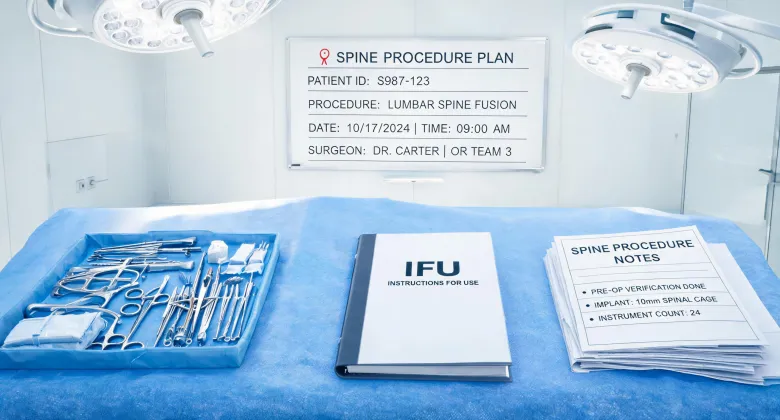
Spinal implants are different on the surface. If a surgeon wants to use NuVasive products, you’re looking at implants and instruments, not one capital device. But the same rule applies. Ask whether the quote includes the instrument set, the instrument repair coverage, sterilization, storage, and loaner trays. If they are not on the quote, they’re still in your budget.
Step 2: Ask for the case count and the reimbursement story
Before I get excited about a new clinical program, I ask two questions. “How many cases do you realistically expect in year one?” and “How does this get reimbursed?”
If a dentist wants a dental chair, one chair can last a long time, so I mainly want to know if the practice volume supports a second or third room. If a spine surgeon requests a new implant line, I ask how many surgeries per month would use it and whether the added cost changes the surgical fee. I don’t need to know every definition of an endoscope to ask whether the endoscopy cases will justify the service contract.
The more complicated version is heart valve replacement. If a heart surgeon wants to start valve replacements, the prostheses may need to be stocked in multiple sizes, and they can be extremely expensive. A realistic case-volume estimate changes the purchasing model. It may be smarter to negotiate a consignment arrangement or rely on a vendor-managed inventory program until the volume is proven, rather than buying many sizes upfront.
This step sounds administrative, but it prevents the most common budget problem: a program that makes sense clinically but loses money because it was priced for an unrealistic volume.
Step 3: Price the after-sale support and repair costs
This is where I’ve been burned more than anywhere else. The quote looks clean. Then the service contract, the repair, and the proprietary parts show up in year two.
For an endoscope, a damaged insertion tube can cost thousands of dollars to repair. Some warranties cover only manufacturer defects, not handling damage. Before buying, I ask for the repair price list and the average repair turnaround. That tells me whether to budget a backup scope.
For a dental chair, I want to know whether parts are proprietary and whether there are third-party service options. If the company is the only one that can fix it, they control the pricing forever.
I remember the moment that changed how I looked at service costs. In March 2023, a procedure room asset was not covered by the agreement we thought we had, and the repair invoice was $4,300 on a machine that cost $16,000 two years earlier. After that, I stopped comparing purchase prices only and forced myself to add a maintenance line item to every capital request.
Spine implant systems include instrument trays that need to be inspected, replaced, and repaired. Ask the manufacturer rep to include an annual instrument maintenance allowance or a replacement schedule.
Step 4: Verify who owns the product line now
The medical device market keeps consolidating. That changes more than you’d think: contract numbers, sales reps, service departments, and even the way products are distributed.
I routinely look up manufacturer ownership before signing anything. The Globus Medical NuVasive merger date is a good example. If you’re reviewing a quote and you see NuVasive products in it, you should know that Globus Medical and NuVasive combined and the deal closed in September 2023. That doesn’t automatically make the quote invalid, but it means the entity you’re buying from may have changed. Ask the rep to reconfirm the pricing, service terms, and warranty under the current corporate structure.
I’ve learned to check this because supplier changes can leave a product suddenly on long backorder or a service contract transferred to a new team. Don’t assume an old catalog still applies. Get the date and the current price list in writing.
Step 5: Build a simple TCO model with three scenarios
After I have the above information, I take the last step: build a small total cost of ownership model. Nothing complicated. I use three columns—low volume, expected, high volume—and three rows: purchase price, service/repair per year, and consumables per case.
Here is an example with an endoscope system. Don’t hold me to the exact numbers; the point is the pattern.
Option A asks $27,000 for the system, $1,500 per year for service, and $30 of supplies per case. Option B asks $22,000 for the system, $1,500 per year for service, and $45 of supplies per case. At 300 cases per year, Option A’s annual running cost is $10,500. Purchase plus five years of running cost gives about $79,500. Option B’s annual running cost is $15,000. Purchase plus five years gives about $97,000.
So Option B was $5,000 cheaper in the capital budget and $17,500 more expensive over five years. If I had made the decision on the lump-sum quote alone, I would have spent more money while thinking I was saving it.
Then I repeat the calculation at 150 cases and at 450 cases. That shows whether the decision still makes sense if the department grows or if the service line struggles.
What if you’re a smaller buyer?
Some vendors ignore small facilities. I don’t accept that. When I was still reviewing a $2,200 annual dental supply contract a few years ago, one distributor never returned my calls. Three years later, at the same facility, I sent out RFPs for a larger scope suite. That silent distributor did not get an invitation to bid.
Small doesn’t mean unimportant. It usually means unproven. A vendor who treats a small request with respect earns the chance to grow with you. That applies to a dental chair, an endoscope, or a first trial order of NuVasive products.
The point isn’t to memorize medical device definitions. It’s to make sure every request is built out of components, volume, service, and ownership. If I can review a dental chair and a spine implant quote through the same lens, you can too. Use the checklist, protect the budget, and make the vendor explain the part they don’t want to talk about.