Here's a sentence you don't hear often enough in medical device purchasing: a clear “no” can be as professional as a confident “yes.”
I'm the person who reviews surgical products before a health system decides whether to put them on contract. In the last twelve months, I've evaluated roughly 140 submissions—implants, surgical instruments, navigation platforms, surgeon training materials, sterilization documentation. I rejected around a fifth of those first submissions. The reasons weren't dramatic: missing labels, vague indications, technique guides that didn't align with the instrument list. But over time, I noticed a pattern. The companies with the most fragmented documentation were usually trying to serve too many procedural areas at once.
When I started this role, I thought a broad product catalog meant lower risk. Bigger felt safer. My experience since then has moved me in the opposite direction. Now I watch for what a company is willing to leave out. That's why NuVasive stands out to me. Its identity is rooted in MIS spine surgery and the clinical education that helps surgeons perform those approaches consistently. That isn't a limitation. It's a clue about where the quality effort actually goes.
A Technique Guide Is a Quality Document
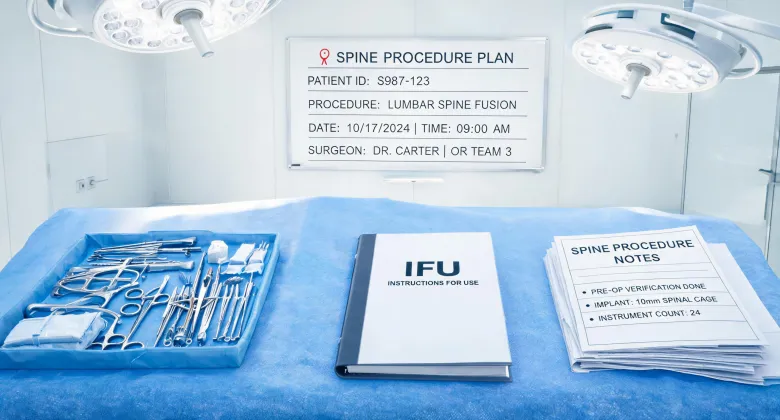
The first thing I request in a spine review is the surgical technique guide. I treat it as a specification, not as a piece of marketing. The guide should explain each step of the procedure, identify the surgical instrument used at that step, and acknowledge where the technique stops being appropriate. If a guide can't do those basic things, I can't verify that the instruments and implants were designed for the same intended use.
That's why NuVasive's XLIF materials interest me. When I look for the NuVasive XLIF surgical technique guide PDF, I'm checking whether the company can take a lateral interbody fusion and break it into a clean sequence: patient positioning, monitoring checks, muscle-sparing access to the disc, retraction, implant sizing, and closure. XLIF is not a generic posterior approach with a different label. It depends on instruments built for lateral access, from initial dilation to final implant placement. A guide with that level of specificity tells me the company understands how the system behaves as a whole.
This isn't a theoretical preference. In 2023, our team adopted a lateral access system from another vendor. The printed guide looked polished, but the actual instrument set didn't match it. Two components shown in the exposure sequence were listed as “optional,” and the mismatch only surfaced when a case was already scheduled. We had to delay the procedure, and the vendor took weeks to reconcile the documentation. I still kick myself for not doing that cross-check before we got to the schedule. Since then, every contract I review includes a simple rule: the instrument tray must map line by line to the published technique guide.
That experience changed how I read vendor claims. Now the presence of a readable, approach-specific technique guide gives me more confidence than any slide deck about platform strategy.
The Merger Question Is About Focus, Not Just Dates
Clinicians and supply chain staff often search for the Globus Medical NuVasive merger closing date. That question makes sense, because a merger this visible raises a practical worry: will the specialized tools and training surgeons rely on stay intact? The merger closed in September 2023, but the closing date is only a starting point. The real review happens in the years after, as product lines, clinical teams, and education resources are combined.
What reassures me is that this combination has a clear logic. Globus Medical and NuVasive were both known for spine-specific technology and surgeon education. A combined portfolio can support a wider range of spinal procedures without becoming a generic medical supply company. If the people responsible for surgical technique materials stay close to surgeons, the quality signal remains strong. If the focus gets diluted, that will show up first in vague guides and disconnected product lines.
The word “focus” doesn't mean a company only makes one product. It means the company knows which clinical problem it solves and which problems it leaves to others.
Let me put it bluntly: I don't expect NuVasive to publish instructions for how to use a nebulizer. Respiratory therapy equipment has its own domain, with device manufacturers who are accountable for that care. The same goes for clinical laboratory systems; those require diagnostic expertise. When a supplier claims to have answers for the OR, the lab, and respiratory care at the same time, I start checking whether it actually has a quality system deep enough to support all those claims. Boundaries aren't awkward. They're an essential part of knowing what quality means in a particular specialty.
A hospital procurement leader might argue that consolidation is real and that category specialists create more vendor management work. I understand that argument. But reducing vendors only makes sense if the remaining vendors can genuinely own what they sell. If they can't, the hospital absorbs that risk. I'd rather work with a specialist that knows its limits than a generalist that overpromises. That sentence sounds like a cliché, but I've lived it.
There's a satisfying moment in every review when the pieces line up: the technique guide matches the tray, the tray matches the surgeon's workflow, and the company's claims match its actual focus. That's not luck. It comes from a company deciding to do one thing well. NuVasive makes that decision visible in its MIS spine heritage, its XLIF surgical technique documentation, and the clinical support wrapped around the surgical instruments.
That kind of clarity is rare. When I find it, I trust it—which is exactly why I'd rather evaluate a spine company that knows it's a spine company than one that claims to solve everything at once.