-
1. What exactly does NuVasive make, and why does it matter to procurement?
-
2. How do I evaluate the true cost of a spinal surgery system?
-
3. What should we look for in wound care products beyond unit price?
-
4. What is an AED defibrillator going to cost over its lifetime?
-
5. What is a stent, and how should procurement approach it?
-
6. What should we verify after the Globus Medical-NuVasive acquisition?
-
7. How do we avoid hidden costs in device contracts?
I've managed procurement for a mid-sized hospital network for 8 years. We spend roughly $2.5 million annually on surgical and emergency medical devices, and I've negotiated contracts with 40+ vendors in that time. So when surgeons, administrators, and new buyers ask me questions about purchasing equipment, I've got answers. Some of them I learned the hard way.
Here are the questions I hear most often in 2025--and the honest answers.
1. What exactly does NuVasive make, and why does it matter to procurement?
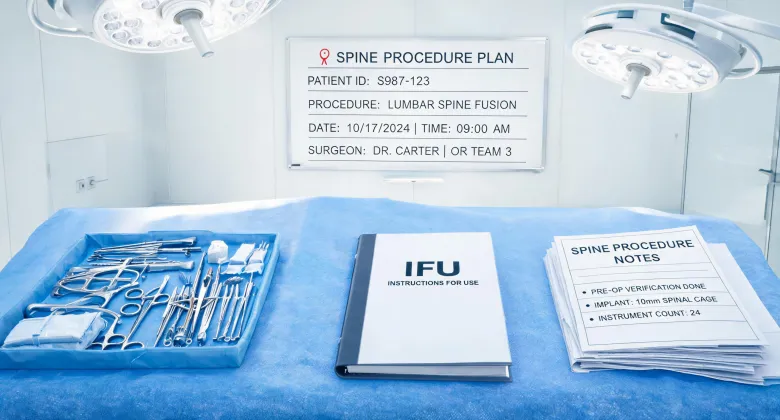
NuVasive designs and sells minimally invasive spinal surgery systems. Their main product lines cover ALIF, TLIF, XLIF, and ACDF--different surgical approaches for the cervical and lumbar spine. Alongside the implants and instruments, they also provide surgical technique education and clinical support services for hospital teams.
Why should procurement care? Because you're not buying a box of screws. You're buying a system that includes instruments, reprocessing, training, and clinical coverage. The implant price is maybe half the story.
Then in September 2023, Globus Medical completed its acquisition of NuVasive. I remember watching that play out in the news. Our spine surgeons worried about product continuity. I worried about contract stability. Both were reasonable concerns--and both are exactly what you should verify when any major device merger happens.
2. How do I evaluate the true cost of a spinal surgery system?
When I first started negotiating device contracts, I assumed the implant unit price was the number that mattered. Then I audited a year of invoices and realized I'd been looking at the wrong thing.
The real cost of a spinal surgery system includes:
- The implant itself
- Instrument sets and reprocessing fees
- Surgeon and OR staff training
- Vendor case coverage during procedures
- Inventory management and consignment terms
Here's a concrete example. In 2024, I compared quotes from two vendors for a TLIF system. Vendor A quoted $2,300 per implant. Vendor B quoted $1,850--a clear winner at first glance. But Vendor B charged $400 per case for instrument reprocessing. Vendor A included it. At 40 cases per year, that's $16,000 in hidden fees. Vendor A was actually $2,000 cheaper per year.
The lowest quote cost us more. That's not an opinion. It's arithmetic.
3. What should we look for in wound care products beyond unit price?
Wound care is the category where cheapest-option thinking does the most damage. I've seen it repeatedly: a budget dressing that needs changing twice as often doubles nursing time and total supply usage.
In Q2 2024, we ran an audit across six departments. We switched from a budget dressing to a premium one at roughly twice the unit cost. The premium dressing required fewer changes per patient per day. When we added nursing labor into the calculation, the 'expensive' option saved us about $14,000 annually across our wound care cases.
To be fair, budget dressings are fine in certain clinical situations--low-exudate wounds, short-duration use, or when nursing availability isn't a constraint. But you have to do the math on labor and change frequency before you default to the cheapest line item on your contract. Unit price isn't total cost. It never is.
4. What is an AED defibrillator going to cost over its lifetime?
AED procurement looks simple on the surface. A defibrillator costs a few thousand dollars, you put it on the wall, done. The reality? The lifetime cost is where the real decisions happen.
What drives AED total cost of ownership:
- Battery replacement cycles (typically every 2-5 years, depending on model)
- Electrode pad expiration and restocking
- Staff training and certification requirements
- Warranty length and service response time
- Software updates and compliance reporting features
In 2023, we replaced 12 AED units across our network. A $2,200 AED with $300 annual maintenance costs more over 5 years than a $2,800 AED with $100 annual maintenance. We learned that the hard way by tracking our own service records.
I don't have hard data on industry-wide AED failure rates. What I can say anecdotally is that our cheaper units needed firmware updates twice as often, and a couple had battery drain issues. When a cardiac emergency happens, you don't get a second chance. Factor that into your evaluation.
5. What is a stent, and how should procurement approach it?
A stent is a small mesh tube used to hold open narrowed or blocked arteries. It's commonly used in coronary and peripheral vascular procedures. If you're in hospital procurement, stents will eventually cross your desk.
Here's what I learned about buying stents: you can't negotiate price alone. Surgeons have strong clinical preferences for specific devices. What works is bringing outcomes data and total cost comparisons to the table so the clinical team can see the whole picture.
In 2022, we consolidated from three stent vendors to two. The savings came from volume-based pricing, not from selecting the lowest-priced option. The third vendor was clinically fine--their products performed well. But maintaining three contracts, three inventory lines, and three training schedules carried overhead that our case volume didn't justify.
Every vendor relationship carries overhead. Not just product cost.
6. What should we verify after the Globus Medical-NuVasive acquisition?
This is the question I'm asked most in 2025. When device companies merge, contracts get messy.
Before renewing or signing anything with the combined Globus Medical-NuVasive entity, verify:
- Which products are continuing, being rebranded, or discontinued
- How existing NuVasive clinical support contracts transfer to the new entity
- Whether pricing tiers change with the combined portfolio
- What the contract termination and transition terms look like
There's real potential for benefit here. The combined portfolio could mean a broader product range and potentially fewer contracts for the same clinical coverage. But that only works if the integration actually reduces total cost without reducing clinical support. Do the due diligence before you sign.
I can only speak to our experience with mergers in the device space. Your situation might be different, so the calculus might be different too.
7. How do we avoid hidden costs in device contracts?
I've built a checklist over the years--after learning some lessons the hard way.
- Define 'case coverage' in writing. Is it on-site during every procedure, or just phone support?
- Ask about reprocessing and sterilization fees separately. They're frequently add-ons that don't show up in the first quote.
- Audit consignment inventory regularly. What's being used versus what's sitting on the shelf collecting dust?
- Confirm whether ongoing training is included in the contract. New surgeons join. Staff turn over. If training isn't covered, that's your cost.
One more thing. I used to think vendor reps were just trying to upsell me. After working with some excellent ones over the years, I've learned to listen--they see more OR cases in a month than I see in a year. But I still verify what they tell me against our own invoice data.
That combination--listening to experts, verifying the numbers, and tracking total cost over time--has saved us more money than any single negotiation ever did.