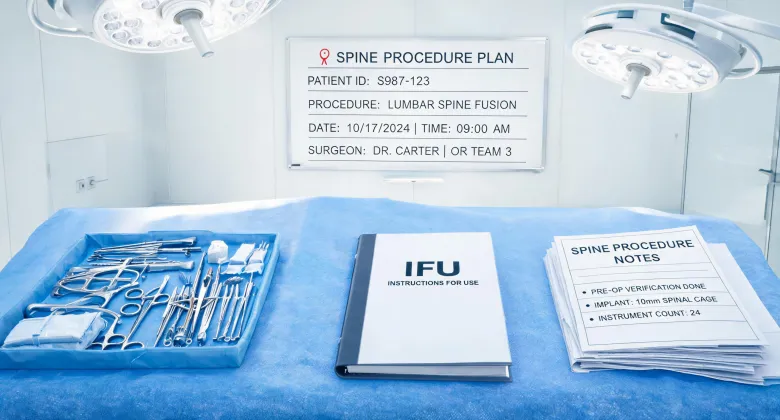
It was 3:07 on a Thursday afternoon when the phone rang. The voice on the other end sounded like they'd been running: a hospital needed a complete spine surgical system—implants, instruments, everything—for a case scheduled the following Tuesday. Normal lead time? Three weeks. They had four business days.
In my role coordinating medical device deliveries for hospitals around the Southeast, these calls are practically routine. I've handled maybe 50 rush orders over the last 7 years. 50-ish. I'd have to check the system to give you the exact number. Same-day turnarounds for outpatient surgery centers that were about to lose accreditation, 48-hour CT scanner deliveries for rural clinics, and 96-hour complete spine system installations when surgery schedules shifted unexpectedly.
Here's what I've learned: not all “urgent” medical equipment is created equal. The differences between surgical systems and diagnostic/monitoring tech matter more than most procurement teams realize.
What We're Actually Comparing
On one side: surgical systems—specifically, NuVasive's minimally invasive spine surgery platforms for procedures like ALIF, TLIF, XLIF, and ACDF. On the other: diagnostic and monitoring equipment—CT scan machines, continuous glucose monitors, and capnography devices. They all fall under “medical devices,” but their procurement profiles are completely different.
I'm evaluating these across four dimensions: procurement urgency, training burden, vendor support, and total cost. These are the four questions every hospital supply chain leader asks when deciding what to prioritize.
Dimension 1: Procurement Urgency—Different Kinds of “Fast”
When a hospital calls about a CT scan machine, “urgent” means something specific: a machine went down, patently patients being rescheduled to other facilities, revenue bleeding out. We've done same-day parts delivery for CT systems and a 48-hour full system install for a rural clinic that had exactly one scanner serving a 60-mile radius. That's fast. But it's also plug-and-play.
A continuous glucose monitor request? Even simpler. We shipped one overnight to a clinic treating a diabetic patient with dangerous glucose variability. Compact device, standard protocol training, done. Capnography? A hospital called at 11 AM because a state inspection the next morning was going to require EtCO2 monitoring in their sedation suite. The monitor was installed and staff was trained by 4 PM. Five hours, end to end.
Surgical systems are a different animal. A NuVasive spine platform isn't something you unbox and hand to a surgeon. The instrumentation has to be matched to the patient's anatomy, the surgeon's preferred approach, and the hospital's sterilization workflow. The shortest realistic window I've seen for a complete NuVasive system delivery was 96 hours—and that only worked because the surgeon had already completed training on the technique.
The conclusion here: monitoring tech rewards pure speed. Surgical systems reward speed plus precision—and the precision part is usually the constraint.
Dimension 2: Training Burden—The Hidden Time Cost
Here's the part that surprises most procurement teams. The device isn't the bottleneck. The training is.
A continuous glucose monitor requires about an hour of in-service training. Nurses are typically comfortable interpreting CGM trend data by the next shift. Capnography? If your staff knows what capnography is—the continuous measurement of carbon dioxide in exhaled breath, used to confirm proper tube placement and monitor ventilation during sedation—they're 90% ready. A 20-minute in-service covers the rest. Even a CT scanner, as complex as it is, has a predictable training arc: the vendor provides a few days of hands-on training for technologists, and they're operational.
Surgical systems? That's a fundamentally different timeline. NuVasive doesn't just deliver hardware—they provide surgical technique education as part of the value proposition. For a procedure like ACDF, the surgeon needs to study the approach, which is where resources like the NuVasive ACDF surgical technique PDF come in. But reading isn't enough. Real competency requires cadaver labs, case observations, and hands-on clinical support visits. That process takes weeks to months.
In March 2024, we delivered a complete NuVasive system to a hospital in 3 days. The implants arrived ahead of schedule. But the surgeon who was going to use it? The earliest slot for their cadaver training was 6 weeks out. The system sat in sterile storage for over a month before it was used.
The conventional wisdom is that equipment lead time is the bottleneck in healthcare procurement. My experience with 50+ urgent orders says otherwise: for surgical technology, the clinical training timeline is the real schedule. Everything I'd read about supply chain management focused on logistics speed—but it's the people side of the equation that takes the longest.
Dimension 3: Vendor Support—When the Merger Actually Helps
The NuVasive-Globus Medical merger came up in almost every hospital conversation last year. A lot of procurement managers were nervous. I was too, honestly. New ownership usually means new processes, new contacts, new chaos.
But the merger has actually helped the urgent-order side of things. The combined portfolio means hospitals work with one vendor across a broader spectrum of spinal approaches. It used to be that a hospital using NuVasive for MIS procedures had to source elsewhere for different cases. Now the combined inventory covers more of the surgical continuum, and that availability directly affects how fast we can respond to emergencies.
Last quarter alone, we had three urgent requests where a hospital needed a specific implant size that wasn't in stock. With the combined NuVasive-Globus inventory, we resolved two of them from the other side of the portfolio. One call, one vendor, one inventory network—instead of juggling multiple distributors and hoping someone has the right size.
Monitoring and diagnostic equipment tells a different story. CT scanners demand service contracts and uptime guarantees—the support question is about replacement speed and maintenance response. CGMs and capnography units are closer to commodity purchases. Vendor support goes from “clinical partnership” to “how fast can you ship a replacement?”
The comparison conclusion: for surgical systems, vendor depth is a lifeline in emergencies. For monitoring tech, vendor speed is the baseline.
Dimension 4: Total Cost—The Sticker Price Never Tells the Story
Everyone asks about price. The answer is always “it depends.” But let me put some real numbers on it so you can see the structure:
- A capnography monitor: roughly $2,000–$5,000 per unit, depending on brand and features
- A continuous glucose monitoring system for hospital use: $200–$500 per patient episode, plus reader hardware
- A CT scan machine: $250,000–$1 million+, depending on slice count, age, and whether it's new or refurbished
- A NuVasive spine system: implant costs vary by case; instruments are typically consigned; clinical training support is bundled into the agreement
The real cost difference isn't sticker price. It's what happens when something goes wrong.
A CT machine down costs an imaging center $5,000–$10,000 a day in lost revenue. A missing instrument set for a scheduled spine case? That's a $40,000–$70,000 surgery canceled, a patient's outcome delayed, and a surgeon's confidence in your supply chain destroyed.
We once paid $800 extra in rush shipping on a $4,000 capnography order. Absolutely the right call—the clinic needed it for an accreditation survey the next morning. But the same logic doesn't apply to surgical systems. Paying $5,000 to expedite a spine system is wasted money if the surgical team hasn't finished their training. The cost driver isn't shipping. It's readiness.
The lowest quote is never the lowest total cost, either. A vendor who charges $200 more for a CGM system but provides on-site training, 24-hour replacement units, and a direct line to a clinical specialist is going to save you money over the device's life. We've seen that pattern repeat across 200+ orders.
What This Means for Your Decision
So which matters more—surgical systems or monitoring tech? The honest answer: it depends entirely on your situation. Here's how to think about it.
Prioritize surgical systems if:
- Your surgeons want to add minimally invasive spine approaches—and they're already trained or committed to the training timeline
- You're building a spine program and need instrumentation that covers multiple approaches from one vendor
- You have the runway to plan around clinical education—cadaver labs, case observations, protocol discussions
Prioritize monitoring and diagnostic technology if:
- You have a compliance or accreditation deadline—capnography for sedation safety, CT for diagnostic capability, CGM for diabetic care protocols
- Your existing equipment is failing and affecting patient care right now
- You need to demonstrate a new capability quickly, like a rural clinic adding capnography or a surgery center standing up a monitored observation unit
And one more thing—this is important. If you're a smaller hospital or surgery center, don't let anyone make you feel like your order doesn't matter. I've seen a $2,000 capnography order get the same focused attention as a $150,000 surgical system order. The vendors who treat small orders seriously are the ones I still trust with the big ones. NuVasive's clinical support team does this right—they've spent as much time helping a small ASC evaluate their system as they have helping a 400-bed hospital.
We had a client—a small ambulatory surgery center doing maybe 40 spine cases a year—ask us to help them evaluate NuVasive systems. They assumed they'd be deprioritized behind larger hospital systems. They weren't. The clinical support team spent two hours on the phone with their lead surgeon, sent over the ACDF surgical technique PDF, and scheduled a virtual OR observation. That surgeon is now doing XLIFs they'd only read about in journals.
Small doesn't mean unimportant. It means potential.
Six years ago, we lost a $300,000 contract because we tried to save $2,000 on expedited shipping for a surgical instrument set. The delay pushed a hospital's entire spine program back by a month. That's when we implemented our 48-hour buffer policy on all clinical-critical deliveries. A lesson learned the hard way—but we only had to learn it once.
Whether you're a single-surgeon practice or a 400-bed hospital, the structure of the decision is the same: understand the real bottleneck, respect the training timeline, and don't treat every urgent request like the same type of fire.
Why does this distinction matter? Because a failed emergency delivery isn't just a delayed order. It's a canceled surgery, a missed diagnosis, a patient outcome compromised. The stakes in medical device procurement are different, and the decision framework needs to reflect that.
Trust me on this one. When you're standing in a hospital supply office at 6 PM on a Friday, trying to figure out whether to expedite a CT scanner part or a spine instrument set, you'll want to know exactly which fire to fight first.