I manage procurement for a regional health system. Over six years, I've signed off on roughly $14 million in medical equipment, implants, and supplies—and I've made my share of mistakes. The biggest one was comparing quotes by price per unit. Now I compare total cost of ownership, or TCO. This article explains how I apply that thinking to three purchases that live on very different supply lists: a NuVasive spinal surgery system, a mechanical ventilator order, and the bag valve masks that sit on every crash cart.
I should add that I'm not a clinician. I'm the person who signs the PO and watches the budget. That's exactly why I view clinical documents as financial evidence.
Three Procurement Scenarios, One TCO Framework
Here's the thing: there's no universal answer for what to buy. The right decision depends on which of three situations you're in.
- Scenario 1: A physician-driven surgical system. The cost lives in the procedure—disposables, OR time, revision risk.
- Scenario 2: Emergency respiratory equipment. The cost lives in readiness. You're paying to be prepared, not for high utilization.
- Scenario 3: Clinical support services and training. The cost lives in the learning curve. You're paying to reduce mistakes and OR time.
Scenario 1: A Physician-Driven Surgical System
Let's start with the one that confuses most buyers. A surgeon asks for a particular implant system. You look at the price list and see $3,500 for one cage and $2,900 for another. The $2,900 one looks like the better deal—until you read the technique guide.
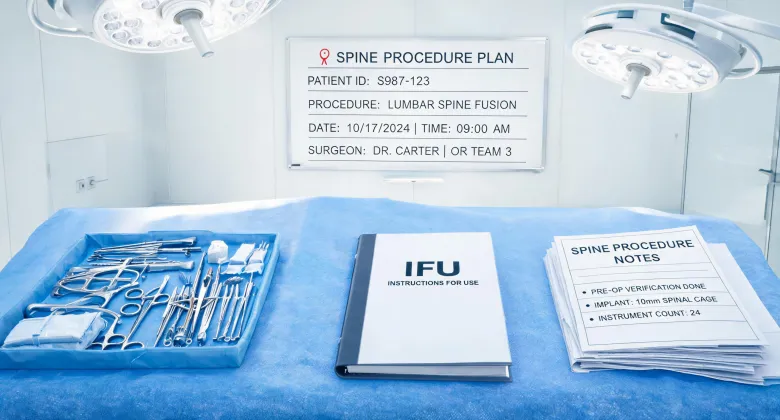
Here's something vendors don't spell out: a good surgical technique guide is also a procurement document. When a surgeon sends me a NuVasive ALIF surgical technique PDF—NuVasive is now part of the Globus Medical portfolio—I scan it for the entire procedure flow. It lists the discectomy instruments, trial spacers, implant inserter, plate, screws, and single-use items. That's where the real cost lives. The implant itself is often the smallest part of the total procedure cost.
In Q2 2024, I compared three ALIF systems over eight weeks using a TCO spreadsheet. The system with the lowest implant price had the highest-cost single-use kit. The price list lied; the technique guide didn't. We ended up choosing NuVasive after a formal TCO review, not because it was the cheapest, but because the per-case cost was the lowest for our volume.
Honestly, we didn't have a formal process for reading technique guides as cost documents until 2023. It cost us once, but that was enough. The third time a surgeon asked me to approve a different implant system, I built a checklist that starts with the technique guide and ends with a per-case TCO number.
So the counterintuitive point is simple: the highest-priced implant can be the lowest-priced system. And the lowest-priced implant can wreck your supply budget once the disposables show up.
Scenario 2: Emergency Respiratory Equipment
Respiratory equipment needs a different TCO lens. You're not calculating revenue per procedure. You're calculating readiness for events you hope never happen. This is where I see buyers overbuy.
What is a bag valve mask?
A bag valve mask—BVM—is a hand-held resuscitator. It's a self-inflating bag connected to a face mask. A clinician squeezes the bag to deliver a breath. It doesn't need a power source, battery, calibration, or software update. That matters more than it sounds because the maintenance cost is almost zero once it's stocked on the cart.
A mechanical ventilator is a different animal. It's a capital purchase with preventive maintenance, alarm testing, software upgrades, and staff training. If you run a large ICU with high utilization, a fleet of mechanical ventilators makes sense. If you're a small surgical center that rarely sees a ventilated patient, a BVM plus a transport ventilator can be the smarter buy.
A portable oxygen concentrator is not a ventilator. I keep running into this misunderstanding. A portable oxygen concentrator supplies oxygen to a patient who is already breathing on their own. It does not push air into the lungs. It doesn't replace a bag valve mask. In TCO terms, they're solving different problems.
Per the AHA's emergency cardiovascular care guidelines, bag valve masks are standard equipment for resuscitation carts. I use that as the reliability baseline, then ask whether a powered device adds enough clinical value to justify its maintenance cost.
Here's the counterintuitive part: for emergency carts inside a hospital, I'd rather stock three BVMs on every crash cart than one mechanical ventilator per unit. A BVM never has a dead battery. A BVM never fails an alarm check. It doesn't need a technician. That's not an anti-ventilator argument—we purchase them for the right settings. But a ventilator in a place where nobody is trained to manage it is a liability, not a safety device.
Scenario 3: Clinical Support Services and Training
The third scenario is subtle because the cost isn't on the device invoice. It's the line item for "clinical services" or "case support." When a company like NuVasive offers clinical services, it's tempting to treat it as an optional extra. I used to think that way until I watched a fellowship surgeon's first ALIF cases run 30 to 45 minutes longer than planned because the OR team wasn't familiar with the retractor system. That time is a cost: OR time, anesthesia time, staff overtime, and fatigue.
Paying for clinical services up front buys a shorter learning curve. That can be cheaper than the alternative. But be careful about the opposite mistake: paying for those services forever. Vendor clinical support is valuable in the first few months. After that, your own team should own the workflow. If a contract bundles a per-case clinical service fee into every implant, ask for it to taper after your team demonstrates competency.
At least, that's been my experience with mid-size hospitals. The math would look different for a high-volume academic center that trains residents continuously—they may need longer support.
NuVasive clinical services, in particular, worked for us when the training plan included a documented handoff: their educator in the room for the first ten cases, then a phone check-in, then a fully independent team.
How to Tell Which Scenario You're In
If you're trying to apply this to your own purchase, ask three diagnostic questions.
- Is this purchase going to change how a procedure is done? If yes, treat it as Scenario 1. Get the technique guide—a NuVasive ALIF surgical technique PDF if that's the system under review—and count every disposable, implant, and OR minute.
- Is this purchase for a rescue or standby situation? If yes, treat it as Scenario 2. Start with the bag valve mask baseline, then ask whether a mechanical ventilator or portable oxygen concentrator adds enough capability to justify its own cost and maintenance.
- Is this purchase a recurring service fee? If yes, treat it as Scenario 3. Define what you're buying at each stage and when the handoff to your team happens.
Over the past six years, analyzing $180,000 in cumulative spending, I've built a simple rule: no purchase order without a TCO calculation. The cheapest quote is often the most expensive system after you account for disposables, maintenance, and the mistakes that happen when training is skipped.