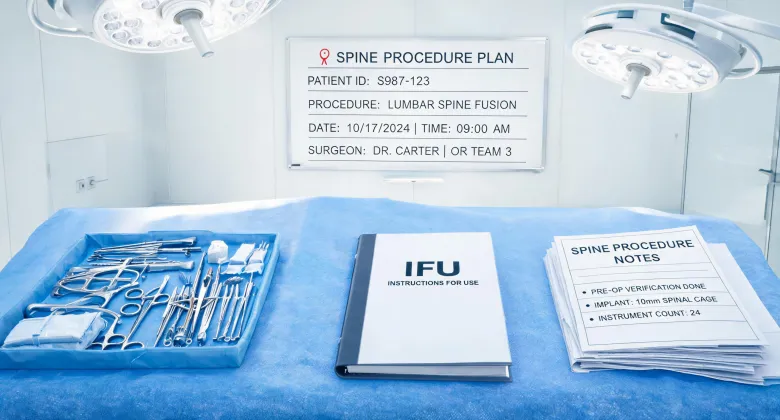
It started with a question that should have been easy to answer.
Mid-2024, I was reviewing a new training module for an MIS spine surgery procedure—a three-level ALIF (anterior lumbar interbody fusion, meaning the approach is through the front of the abdomen). I was seated next to a spine surgeon who was watching a dry run. Halfway through, he turned to me and asked: 'What is infection control, exactly, in this procedure?'
I went to answer, and then I stopped. The module had a slide titled 'Infection Control.' But it only listed 'sterile technique, antibiotics, limit OR traffic.' It didn't explain the why.
The Background: The Gap Between Comprehensive and Visible
I'm a quality and brand compliance manager at NuVasive Medical, which now operates as part of Globus Medical. I've spent four years reviewing the clinical education materials that go out to hospitals and surgeons—surgical technique guides, OR support documents, NuVasive Clinical Services training decks, that sort of thing. I review roughly 200+ unique items a year. About 12% of first submissions get rejected, most often because a claim isn't backed up or a video doesn't match our actual instrumentation.
NuVasive Clinical Services is one of the strongest parts of the company, honestly. Unlike a typical implant manufacturer that ships a box and disappears, the clinical team supports the entire surgical journey—from patient selection through post-op. That's what made the infection control moment hard to swallow.
We were building something good. But we had let a foundational topic become a checklist.
The Process: One Question Unraveled a Whole System
The surgeon's question became a test for every module. I went back through the 42 modules scheduled for release in Q3 2024 and reviewed each for basic clinical safety concepts. 'What is infection control? What does it have to do with MIS spine? How is infection risk different after ALIF vs TLIF vs XLIF vs ACDF?'
I rejected 11 modules in the first pass.
The most frustrating part of that review: the same issue kept coming back. A module would have beautiful 3D imaging, the correct steps for a posterior approach, and then a vague statement like 'use standard infection prevention measures.' Every surgeon asked a different version of the same question: 'What measures? Who's responsible? What do we do if the surgical site looks infected after discharge?'
You'd think written specs would prevent this. But the modules weren't wrong—they were incomplete. That's harder to catch.
A Rabbit Hole: Blood Analyzers and Scope Creep
At the same time, one of our clinical educators proposed adding a reference to a point-of-care blood analyzer in the XLIF module. The idea was to help surgeons assess blood loss and make transfusion decisions in real time. She argued that a blood analyzer could be more accurate than visual estimation (and she wasn't wrong).
I went back and forth on this for a week. The blood analyzer isn't a NuVasive product. Adding it could be seen as an endorsement, and we hadn't validated its performance in the context of spinal fusion. Plus, we had no data with our own implants.
On the other hand, the concept was genuinely useful: knowing a patient's hemoglobin trend during a prone TLIF would help surgeons gauge whether a transfusion is necessary. The clinical services team has always been about being an extra set of hands in the OR, not just a vendor. If we didn't mention the tool, no one would stop using it; we'd just miss a teachable moment.
The decision kept me up at night. On paper, including a third-party reference looked progressive. But my gut said it diluted our role. We're not qualified to approve a blood analyzer. We're qualified to teach spine surgery and clinical support.
I ultimately chose to cut it. Not because the analyzer was bad, but because our compliance boundary wasn't clear. The lessons we included about blood loss monitoring—without naming a specific device—are still valuable. That was a moment of scope clarity: NuVasive Clinical Services should focus on what we can control, not everything that happens near an OR. (Which, honestly, felt like the right call once the emotion settled.)
What Infection Control Actually Means in This Context
Since this article targets the question 'what is infection control,' let me answer it the way I would expect our modules to answer it.
Infection control is the set of practices designed to prevent healthcare-associated infections (HAIs). That includes hand hygiene, sterile gowning and gloving, skin preparation, environmental cleaning, proper handling of implants, surgical site infection surveillance, and prudent antibiotic use. It's a system, not a single action.
Per the CDC's isolation precautions guideline, infection control is built on standard precautions—treating all blood and bodily fluids as potentially infectious—plus transmission-based precautions when needed. According to CDC (cdc.gov), about 1 in 31 hospital patients has a healthcare-associated infection on any given day. In spine surgery, the biggest infection risks relate to wound contamination, hematoma, and biofilm formation on an implant. It's why our technique education is as much about tissue handling as it is about implant placement. (Yes, the surgeon's question turned into a whole internal briefing.)
'When someone asks what is infection control, don't answer with a list. Explain the chain of prevention: sterile field, host defenses, antimicrobials, and prompt identification of a problem.'
The Turn: We Rebuilt Instead of Patching
Here's where the story could have ended the easy way: fix the 11 modules, add a new infection control slide, send them out, and call it a win. But our team had learned too much. We decided to rebuild the NuVasive Clinical Services education framework from the ground up.
This meant treating infection control as a cross-cutting theme, not a standalone chapter. Each surgical technique module now includes a section called Patient Safety with clear, verifiable content about risk factors, prophylactic antibiotics, and post-op warning signs. We added references to CDC guidelines and hospital protocols. We even changed the language of the patient education handouts so nurses could answer basic questions without having to page the surgeon.
The rewrite was hard. Some of our best narrators had to re-record segments. Our medical illustrator redrew the wound closure step to show the subcutaneous layer more clearly. In the final review, I rejected only 2 of the revised modules, and one of them came back because a video frame showed a watch on the assistant's wrist. (Yes, really.) The details matter because infection control is in the details.
A Colleague's Prosthetic Limb Story
One thing that helped me reframe our quality bar was talking to a friend who works on prosthetic limb fit and alignment. He told me about a test where they compare a socket under load to a digital model. 'If the fit is off by two millimeters, the patient feels it every step,' he said. 'Functional prosthetics have no tolerance for sloppy verification.'
For us, spinal implants are similar. A surgeon can't see a patient's back pain the way a patient can feel an ill-fitting socket. But the standards should be just as strict. That conversation helped me articulate why NuVasive Clinical Services is more than a marketing arm: it's a clinical capability that affects outcomes. And quality is what makes it trustworthy.
I still kick myself for not catching the infection control gap earlier. If I'd run a quick 'what is infection control?' scenario review with the curriculum team back in Q1, we could have avoided a rushed rewrite. But the lesson stuck: a quality reviewer can't just check wording. Sometimes you have to question the assumptions underneath the text.
What I'd Tell Another Quality Reviewer in Medical Devices
If you're in a similar role, here are three takeaways from this experience:
- Look for implicit assumptions. If a module says 'standard infection prevention measures,' ask 'for whom? in what setting? under what evidence?' That's where the real learning happens.
- Respect your scope. It's tempting to expand into adjacent topics—like adding a blood analyzer reference or broad clinical recommendations. But unless you're ready to hold that content to the same standard as your core product, leave it out or partner with someone who can.
- Use official sources as your ground truth. For infection control, the CDC's guidelines are a solid baseline. And for any marketing or educational claim, the FTC's advertising guidance (ftc.gov) requires substantiation—that isn't just a legal detail; it's a useful editorial test.
In fact, one of the best changes we made was adding a 'source required' rule for every clinical statement. If it's a factual claim about outcomes or infection rates, it must have a citation and a date. If it's an opinion, it's clearly labeled as such.
The phrase 'what is infection control' may sound basic in a world of robot-assisted spine surgery and advanced biomaterials. But the fundamentals haven't changed; the execution has transformed. A five-year-old best practice may be outdated in 2025, but the core principles—clean hands, clean instruments, clean environment, and a team that knows how to react—remain the same.
At NuVasive Medical, we've gotten better at this. Our education now feels more like the clinical services we actually deliver: practical, evidence-driven, and honest about uncertainty. To be fair, it required more upfront work. But it saves time later and, more importantly, it gives surgeons something they can rely on in a busy OR.
The next time someone asks me what I do for a living, I won't say 'I check compliance.' I'll say: I help make sure that when a surgeon receives a NuVasive Clinical Services education material, the last thing they have to worry about is whether the information is accurate.
That's the kind of infection control we take seriously.