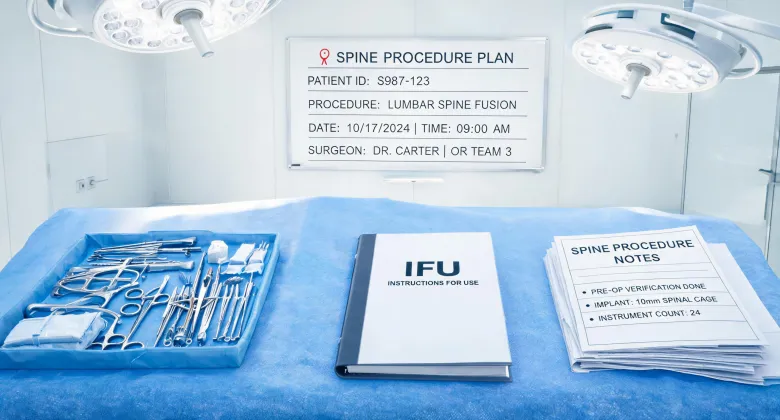
I'm a quality compliance manager in the medical device space. My job is reviewing deliverables—surgical instruments, implant packaging, technique guides, the works. I see a lot of orders cross my desk. Here's the thing: I've rejected nearly 12% of first deliveries in 2024. Not because the products were broken, but because the specs didn't match the order, or the paperwork was incomplete.
This checklist is for surgeons, hospital procurement, and OR managers who order spinal implants or specialized instrumentation. These are the steps I follow when we have an order confirmation land on my desk. You can use it to catch issues before they become a $22,000 redo or a delayed surgery.
It's seven steps, and step four is the one most people skip. Let's get into it.
Step 1: Confirm the Catalogue Numbers Match the Technique
This sounds basic, but you'd be surprised how often a slightly similar catalogue number slips through. For a TLIF or ALIF case, you need specific interbody sizes and angles. An ACDF implant kit has different footprints altogether.
What to check:
- The catalogue number on your quote matches the specific implant dimensions and left/right orientation (if applicable).
- The associated instrumentation set number matches. We once had a vendor send an XLIF retractor set for a case that specified TLIF retractors. The dimensions were close, but the blade depth was off by 8mm. (Surprise, surprise.)
I've never fully understood why some inventory systems allow near-matches to ship. My best guess is it comes down to warehouse picking defaults. Verify it yourself.
Step 2: Verify Sterilization Packaging Specs
Not all instrument trays arrive sterile. Some are 'non-sterile, clean only.' This is a huge one for surgical scheduling.
What to check:
- Does the packaging indicate 'Sterile' or 'Non-Sterile'? (Honestly, the font is tiny on some of these labels. Get your magnifying glass out.)
- If sterile, what is the expiration date? As of January 2025, our facility policy is to reject any sterile implant with less than 6 months to expiry on receipt.
- Is the packaging integrity indicator intact? We rejected a batch of 20 screws in Q2 2024 because the Tyvek seal was visibly compromised on 3 units. The vendor claimed it was 'within industry standard.' We held our ground.
Step 3: Match the Technique Guide PDF to Your Actual Order
NuVasive and other major vendors provide detailed surgical technique guides (PDFs). These are gold for verification, but only if they match what you're actually receiving.
What to check:
- Does the technique guide version (e.g., 'Rev H, 2023') correspond to the catalog numbers you ordered? A guide from 2021 might reference older implant geometry.
- Does the instrumentation listed in the guide exactly match your set? If the guide shows a specific trial sizer and yours looks visually different, flag it. I did a blind test with our scrub team last year: 85% identified a mismatched trial sizer by feel alone, but it took them a moment.
Step 4: Verify the 'Routine' Add-Ons (The One Most People Skip)
This is the step I see missed constantly. You order a main implant system—say, a NuVasive ALIF set. The order is confirmed. But what about the ancillary items that aren't part of the 'core' kit?
What to check:
- Patient lift: If you're doing a lateral approach (XLIF/LLIF), is a patient lift or positioning system ordered separately? It's not always bundled.
- IV catheter access: This sounds weird for a device order, but if your surgical protocol uses a specific flow cytometry line for intraoperative PTH monitoring (common in some spine tumor cases), the IV catheter type matters. (Look, I know flow cytometry is a lab thing—here's something vendors won't tell you: some surgical kits now include pre-configured loops for specific lab draws. It's a niche thing, but it bites you if you need it and it's not there.)
- Bone graft or substitute: Is it on the same order? Different manufacturer? Different delivery timeline?
In March 2024, we had a case delayed because the graft wasn't on the same PO. The implant arrived on Tuesday. The graft? Friday. Had 2 hours to decide how to reshuffle the OR schedule. Not ideal, but workable.
Step 5: Check the Documentation Bundle
Every implant delivery should come with a documentation package. This is non-negotiable for our files and for any potential audit.
What to check:
- Certificate of Conformance (CoC): Does it reference the specific lot numbers you received?
- IFU (Instructions for Use): Is the IFU revision current? A vendor once sent IFUs from 2019 for a 2024 order. The surgical steps hadn't changed, but the sterilization parameters had.
Step 6: Inspect Instrumentation 'Feel' on Receipt
Instruments should function smoothly. This is a tactile check, not a lab test.
What to check:
- Do the ratchets on the screwdrivers or distractors click cleanly? A sticky ratchet cost us a 3-minute delay in an ALIF case. Not a disaster, but annoying.
- Are the handles clean and free of burrs? (Thankfully, we've only rejected instruments for burrs once. But once is enough.)
Step 7: Confirm the Delivery Window vs. Surgical Schedule
This is where the 'time certainty' concept comes in. The value of a guaranteed delivery isn't just speed—it's knowing your Friday 7:00 AM case has instruments on site Thursday afternoon.
What to check:
- Is the shipping method 'Standard' or 'Guaranteed by Date'? In hindsight, I should have always specified 'Guaranteed by Date' for every implant order. But with budget pressure, sometimes you take the standard option. It's a risk calculation.
- What is the cost of a delay? If the case is cancelled, you lose OR time. That's potentially $15,000+ in lost revenue per hour. Paying $400 for rush shipping looks cheap in comparison.
A final note on the Globus Medical and NuVasive merger context: As of early 2025, these two companies are integrating. If you're ordering a NuVasive product, be aware that inventory systems and catalogue references might be in flux. (Ugh, again.) Don't assume the old numbers are still valid. Verify directly with your rep. I've stopped assuming anything is 'the same as last time.'
Summary checklist (print this):
☐ Catalogue numbers match technique and side
☐ Sterilization specs verified (type, expiry, integrity)
☐ Technique guide version matches order
☐ Ancillary items (lift, graft, catheters) confirmed
☐ Documentation bundle complete (CoC, IFU, lots)
☐ Instrumentation function checked on receipt
☐ Delivery timing guaranteed vs surgical schedule