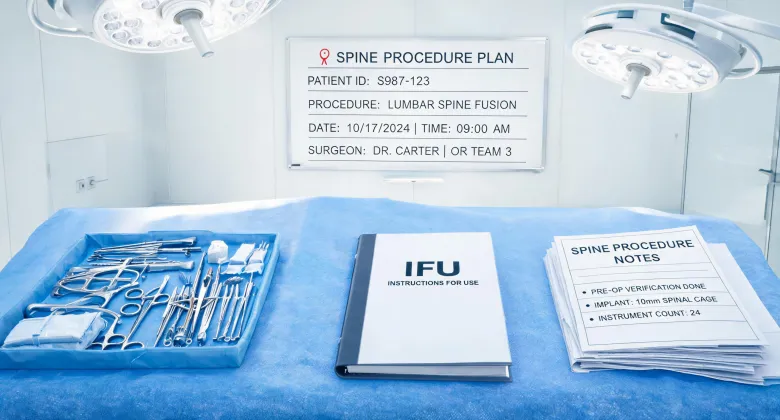
I used to think buying for a hospital surgical center was about getting the best price on the implant. That's what everyone focuses on, right? You get three quotes, you pick the lowest number, and you move on. That logic cost my department roughly $12,000 in hidden fees and operational headaches in my first 18 months. I'm not proud of it, but I documented every mistake so my team wouldn't repeat them. Here's what I should have known about the total cost of a surgical technique package.
Unit Price is a Trap. Here's the Proof.
Most buyers focus on the per-unit cost of a pedicle screw or an interbody cage. It's the obvious number. The question everyone asks is, 'What's your price for a TLIF case?' The question they should ask is, 'What's included, and what happens when something goes wrong?'
I learned this the hard way in September 2022. We needed a standard TLIF technique kit. One vendor quoted the implants at $X, another at $X plus 15%. I picked the cheaper option. What I didn't account for was their 'instrumentation loaner' fee—$850 per case if we didn't return the kit within 48 hours. The first case had a one-day delay due to a scheduling conflict. That $850 hit, plus the expedited return shipping of $190, ate up the entire price advantage. The more expensive quote was, in reality, the cheaper option.
The Hidden Costs Nobody Talks About
I've started calculating TCO (Total Cost of Ownership) before comparing any vendor quotes. And what I've found is that the 'cheapest' option isn't just about the sticker price—it's about the total cost including your time spent managing issues, the risk of delays, and the potential need for redos.
"The $500 quote turned into $800 after shipping, setup, and revision fees. The $650 all-inclusive quote was actually cheaper."
Here are the categories I now track. You might be missing some:
- Setup and delivery fees: Does the quote include delivery to the OR? Is there a surcharge for after-hours or weekend delivery? NuVasive's clinical services team, for example, often coordinates these logistics, but not every vendor does.
- Instrumentation loaner costs: Are the surgical instruments included? If you need a specific technique set (like the NuVasive Reline surgical technique kit), is there a daily or per-case rental fee?
- Revision risk: What's the cost of the implant if it needs to be removed or revised? Some vendors have a 'revision discount,' others charge full price for a second implant. That's a $1,200+ risk per case.
- Training support: Does the vendor provide a clinical specialist for the first few cases? If not, your surgeons' learning curve adds OR time, which is expensive. Per FTC guidelines (ftc.gov), claims about 'case support' must be substantiated. I now ask for it in writing.
- Time cost: How much of my team's time is spent managing this vendor? The quote that saves $300 but requires 10 hours of follow-up isn't a bargain. It's a liability.
According to USPS pricing effective January 2025 (usps.com/stamps), a simple First-Class stamp costs $0.73. That's easy. But compare that to a complex surgical kit where every component—cages, screws, rods, instruments—has a separate price and policy. It's a mess.
The 'Cheapest' Vendor Cost Me a Surgeon's Trust
I once ordered 30 ALIF cages from a 'budget' vendor. Checked the price myself, approved it, processed it. We caught the error when the surgeon opened the kit and saw the instruments were for a TLIF approach, not an ALIF. $3,200 wasted on the wrong implants, plus a 3-day delay while we sourced the correct items. Credibility damaged. Lesson learned: price is not quality, and quality is not optional when a surgeon is holding a patient's spine open.
People think expensive vendors deliver better quality. Actually, vendors who deliver quality can charge more. The causation runs the other way. A vendor like NuVasive, which has standardized surgical technique guides (like the XLIF and TLIF PDFs you can find online), has invested in making their process repeatable. That investment shows up in the price, but it also shows up in reliability. I'll pay for reliability every time.
What's the Alternative? A Simple Checklist
After the third rejection in Q1 2024, I created a pre-check list. It's not fancy. It's a spreadsheet. But it's saved us from at least seven potential disasters since then.
Here's the core of it:
- Get the total case cost in writing, broken down by: implant, instruments, delivery, training, and revision policy.
- Ask for the 'all-in' price for a standard case. If the vendor hesitates, that's a red flag.
- Verify the surgical technique. Does the kit match the procedure? (TLIF vs. ALIF vs. XLIF are not interchangeable.)
- Calculate the worst-case cost: what if the first implant fails and you need a revision? That's the real price.
- Check the return policy. No one plans for a cancelled case, but it happens. $2,000 worth of opened-but-unused implants sitting in your storage is a sunk cost.
Now, I know what you're thinking: 'This is just basic procurement.' You're not wrong. But basic procurement goes out the window when you're under pressure to get a case on the schedule. I've been there. I made the mistake.
Looking back, I should have invested in better specifications upfront. But given what I knew then—nothing about the vendor's interpretation of 'standard kit'—my choice was reasonable. My mistake was not knowing what questions to ask. My team now knows.
So What's the Bottom Line?
The $500 quote is a trap. The $650 quote might be the bargain. The only way to know is to calculate TCO. I'm not saying NuVasive or any other brand is 'the best.' I'm saying that buying on price alone is a fool's errand. You'll pay for it in time, trust, and redo costs. I've got the spreadsheet to prove it.
Don't learn this lesson the hard way like I did. Ask for the all-in price. Ask about the revision policy. And for heaven's sake, ask what happens if the kit is late. That's the question that cost me $850 once.