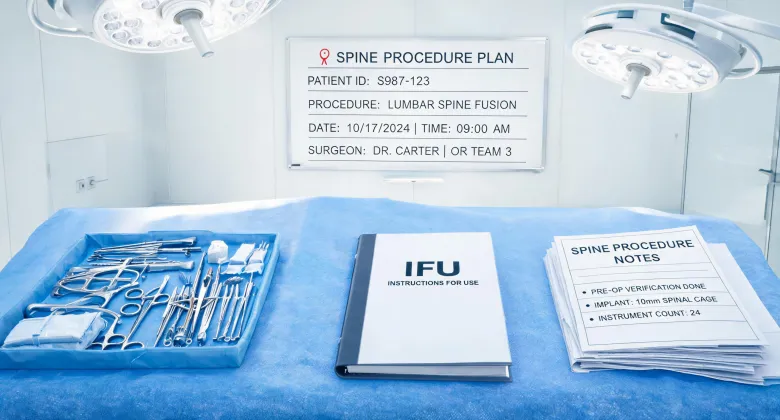
This checklist is for anyone who has to verify a NuVasive implant or instrument delivery before it hits the OR. Surgeons who double-check their own kits, hospital procurement teams doing inbound QA, or clinical staff who get handed a tray and need to know it's right. I'm a quality manager in med dev. Before any NuVasive set goes into inventory, it passes through my review. I've rejected roughly 12% of first deliveries this year alone for spec mismatches. Here's the process I follow. Four steps.
Step 1: Verify the Implant Label Against the Surgical Technique Guide
This is where most errors live. The implant label says one thing; the surgical technique guide for the specific approach says another. You'd be surprised how often they don't match.
For a TLIF case, the technique guide will specify the cage dimensions (height, lordosis, length) and the corresponding inserter part number. Pull the implant out of its sterile packaging. Check the lot number against the label. Then cross-reference the part number with the NuVasive surgical technique PDF for that specific approach. Not a general catalog—the specific PDF for TLIF or ALIF or ACDF.
In Q1 2024, I had a batch where the implant label was correct but the lot number had been swapped on two adjacent boxes (surprise, surprise). Only caught it because the lot on the packaging didn't match the lot on the inner seal. That's a $2,000 per implant redo, plus shipping both ways. Now every contract I manage requires the lot number to be printed on both the outer and inner packaging. Non-negotiable.
Checklist item: Implant part number = technique guide spec? Lot number matches inner and outer packaging?
Step 2: Measure the Instrument Against Published Spec Tolerances
Instruments wear. They also come from the factory slightly wrong. I'm not an engineer, so I can't speak to machining tolerances at the micron level. What I can tell you from a quality perspective is how to verify a surgical instrument against its published spec.
NuVasive publishes instrument specs—length, diameter, working tip dimensions. For a pedicle screwdriver, the spec sheet will say the hex tip is 3.5mm. Take a calibrated gauge and check it. Industry standard tolerance for surgical instruments is typically ±0.1mm on critical dimensions. Outside that, the instrument is out of spec.
Here's the thing most people skip: they check one instrument from a tray and assume the rest are fine. I've rejected a complete set of six screwdrivers where four were within tolerance and two were 0.15mm off. The variance was noticeable during insertion—the surgeon felt it. If you're reviewing a kit, measure every critical instrument, not just the first one.
Checklist item: Critical dimensions within ±0.1mm of published spec? Every instrument in the set measured?
Step 3: Confirm the Sterile Barrier Integrity and Labeling Compliance
People forget that the package itself is part of the spec. The sterile barrier has to be intact. Simple, right? You'd think. But I've seen pouches where the seal was compromised by 1mm on one corner—barely visible to the naked eye. The shipping team said it was 'within industry standard.' I rejected the batch. Normal tolerance for a sterile seal is zero gaps. Period.
In 2023, I had a vendor deliver 8,000 units where the Tyvek seal had a pinhole defect in the same spot on every pouch—probably a manufacturing flaw. The defect ruined the entire batch in storage, and we had to quarantine 8,000 units. That's a $60,000 loss on paper, but the real cost was the OR time we had to scramble to cover. Now I do a dye-penetrant test on every new packaging batch before it enters our inventory. Takes 10 minutes per sample and has caught three defects since.
Checklist item: Sterile seal intact? Dye-penetrant test passed on new packaging lots? Label includes expiration date, lot number, and sterilization method?
Step 4: Run a Blind Fit-Check on the Implant-Instrument Interface
This is the step nobody documents but everyone should do. You can check every spec on paper and still have an implant that doesn't seat into the inserter correctly. The spec says the interface is compatible, but real-world manufacturing tolerances stack up.
I run a blind test: I give a random implant and the corresponding instrument to a scrub tech. I don't tell them if it's supposed to fit or not. They try to assemble it. If it clicks in cleanly, perfect. If it's tight or doesn't engage, I flag it.
Last year, I had a batch of ALIF cages where the inserter tip was 0.05mm larger than spec. The implant went in, but you had to apply enough force that it could have compromised the cage threads. The vendor claimed it was 'within tolerance.' We ran the blind test with three techs, and all three said it felt wrong. The vendor ended up reworking the batch at their cost.
Checklist item: Implant seats into inserter with no resistance? At least two staff members confirm the interface feels correct?
Common Mistakes and Gotchas
- Assuming the label is right. I've seen labels swapped on same-model instruments in the same case. Verify each one individually.
- Skipping Step 2 because 'it's from the same batch.' Manufacturing variance exists. Measure a sample from every lot.
- Not checking the sterile barrier under bright light. Turn the pouch and inspect from multiple angles. Pinholes are easy to miss.
- Taking the vendor's word on 'industry standard.' Industry standard is a minimum. Your spec should match the published NuVasive document, not a vendor's interpretation.
- Forgetting the technique guide. The surgical technique PDF is your source of truth, not the catalog or the implant label alone.
If you follow these steps, you'll catch the vast majority of spec errors before they reach the OR. I've had weeks where I flagged three different issues in a single delivery. It's tedious. It's worth it.
This gets into surgical technique territory, which isn't my expertise. I'd recommend consulting the specific NuVasive TLIF or ALIF technique guide for interface compatibility details beyond the spec check.
