The Budget That Kept Growing
I remember sitting in my office in early 2024, staring at our spine surgery department's P&L. We'd budgeted $180,000 for the year. By March, we were already 15% over. The surgeons were happy. The patients were getting great outcomes. But I was the one who had to explain to the CFO why our instrument and implant costs were spiraling.
So I did what any procurement manager with 6 years of tracking invoices does. I opened my cost tracking system—a sprawling spreadsheet I'd built over the years—and started digging. At first, I thought the problem was obvious: implant prices. But as I got deeper, I realized the implant was just the tip of the iceberg.
The real costs were hiding in the fine print, the workflows, and the assumptions we'd all made.
The Surface Problem: Implant Pricing
When most people talk about the cost of spinal surgery, they focus on the implant. The interbody cage, the screws, the rods. And sure, those are big-ticket items. For a typical TLIF (transforaminal lumbar interbody fusion) case, implant costs can range from $5,000 to $15,000 depending on the system and the hospital's negotiated contracts.
But here's the thing: I've compared pricing across 8 different vendors over the last 3 years, and the implant price itself is surprisingly similar when you account for the core specifications. The real divergence happens when you start adding in everything else.
Ninety percent of my budget overruns in 2023 came from things that weren't the implant itself. And that's a problem because most hospitals still negotiate based on implant pricing alone.
The Hidden Costs Revealed
After tracking 47 spine surgery orders over the past two years in our system, I found some patterns that would make any cost controller's blood boil. Let me walk you through the three biggest ones.
1. The Surgical Technique Training Gap
Here's a dirty little secret: most implant companies provide PDFs of their surgical techniques—NuVasive has excellent ones for ALIF, TLIF, ACDF, and XLIF. But reading a PDF and actually being proficient in a technique are two different things.
I assumed 'surgical technique training' was included in the implant cost. Didn't verify. Turned out, for one vendor, we were billed an additional $4,200 for a two-day on-site training session. That's not unusual. Some vendors bundle training; some don't. And if your surgeons need extra cases to get comfortable with a new approach—especially something like XLIF which has a learning curve—those training costs add up fast.
"Learned never to assume the training is included. Now our procurement policy requires quotes to specify training costs line-item, or the deal is off."
2. The Instrument Tray Hidden Costs
This one nearly got me. When we signed a contract for a new ALIF system, the implant price was competitive—about 12% lower than what we were paying before. Great deal, right? Then the sterilization department started complaining.
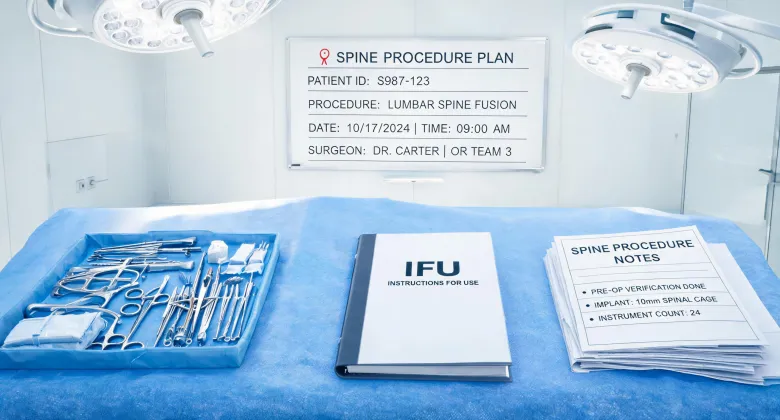
The new system required 17 instrument trays per case. The old system required 12. More trays means more sterilization cycles, more handling, more storage space, and more risk of lost instruments. I calculated the total impact: about $850 per case in additional sterilization and logistics costs. That ate up most of my implant savings.
Most frustrating part: the vendor quoted 'trays included.' They were included—I just didn't ask how many. You'd think a tray is a tray, but the system design has a massive impact on your workflow costs.
3. The Merger Uncertainty Factor
This one's fresh. In 2024, Globus Medical completed its merger with NuVasive. The deal was valued at roughly $3.1 billion. From a procurement standpoint, that creates real uncertainty.
When two companies merge, product lines change. Some get consolidated. Some get sunset. Support staff gets reorganized. I've seen it happen before—a merger that looked like a good thing on paper turned into a nightmare when the product we'd standardized on was discontinued 18 months later.
For a spine surgery system, that's a catastrophic risk. If you've trained your surgeons on a specific approach, and the implant system changes, you're looking at retraining costs, new instrument purchases, and potential disruptions to surgical schedules. In Q2 2024, when we evaluated our options, I factored in a 15% 'transition risk premium' for any post-merger product line. That's not a number I pulled from thin air—it's based on tracking three similar medical device mergers over the past decade.
The Cost of Not Solving This
So what happens if you ignore these hidden costs? Let me give you a real-world example.
In 2022, we switched vendors on an ACDF system. The implant quote was 8% lower. We saved about $600 per case on the hardware. But because the new system required different instruments, we had to purchase $28,000 worth of new trays. The training cost another $4,200. And because the surgeons weren't as comfortable with the new system, OR times increased by an average of 12 minutes per case in the first 30 cases. At $50 per minute for OR time, that's $600 extra per case.
"After 50 cases, our 'cost savings' had turned into a net loss of about $15,000. The cheap option resulted in a costly redo when quality and efficiency suffered."
That experience changed how I evaluate everything now. I built a total cost of ownership calculator that includes: - Implant pricing (obviously) - Training costs (on-site, off-site, refresher) - Instrument tray count and sterilization impact - OR time changes during learning curve - Product line stability risk - Support staff availability post-merger
A Smarter Approach to Budgeting
So glad I learned this lesson the hard way early in my career. Almost made the same mistake twice. After comparing 8 vendors over 3 months using my TCO spreadsheet, here's what I'd tell any hospital procurement team evaluating spinal surgery systems.
First, get everything in writing. I mean everything. Training costs, instrument tray count, sterilization requirements, support staff ratios, and product lifecycle commitments. If a vendor can't commit to supporting a product line for at least 5 years, that's a red flag.
Second, evaluate using TCO, not per-unit cost. The implant might be 10% cheaper, but if the total system adds 15% to your operational costs, you're losing money. And don't forget the cost of surgeon time—if your OR is running 10 extra minutes per case because the instruments aren't intuitive, that adds up fast.
Third, factor in merger risk. With the Globus Medical-NuVasive merger, I'd recommend asking specific questions about product line continuity, support team structure, and any planned changes to surgical technique protocols. What was best practice in 2020 may not apply in 2025, but the fundamentals of a good system—reliable instruments, predictable costs, and strong support—haven't changed.
Finally, build in buffer time and money. I now allocate an extra 10% of any new system budget for unexpected costs. It's not pessimism—it's experience. After the third late delivery from the same vendor, I was ready to give up on them entirely. What finally helped was building in buffer time rather than trusting their estimates.
The fundamentals of spinal surgery haven't changed. Patients still need safe, effective procedures. Surgeons still need reliable tools. But how we budget for those tools has to evolve. A vendor relationship isn't just about the implant price—it's about the total system that supports it. Get that right, and your budget will thank you.
